Just in time for the holidays, this month's Movie Dearest Calendar Wallpaper salutes cinematic sisterhood with a December dose of Nun's Stories.
As you can see, there's nothing like the role of a nun to attract the attention of our favorite movie actresses, from Ingrid Bergman and Rosalind Russell to Audrey Hepburn and Julie Andrews to Whoopi Goldberg and Meryl Streep. In everything from dramas to comedies to musicals, it's hard to break the habit of a good nun's story.
All you have to do is click on the picture above to enlarge it, then simply right click your mouse and select "Set as Background". (You can also save it to your computer and set it up from there if you prefer.) The size is 1024 x 768, but you can modify it if needed in your own photo-editing program.
Wednesday, November 30, 2011
Tuesday, November 29, 2011
Reverend's Reviews: Here Comes Santa Claus
Who knew your average shopping mall Santa has to risk so much? From crying, inconsolable toddlers to sick children vomiting on their freshly-laundered suits and the "post-Christmas depression" that sets in for many of them come December 26th, it isn't easy being the North Pole's jolliest inhabitant. The illuminating, highly enjoyable new documentary Becoming Santa (now available on DVD
just in time for the holidays from Cinema Libre Studio) reveals all these perils of the trade as well as its many joys.
"It's not a job; it's a calling, a destiny," according to one interviewee in the film who annually dons the familiar red and white. Director Jeff Myers primarily follows the journey of Los Angeles resident Jack Sanderson, who found Christmas had lost much of its value and meaning following the deaths of his parents. The funny, well-spoken Sanderson decided to try to re-discover the holiday spirit by growing out his beard, dyeing it white and attending one of several schools for professional Santas scattered across the US. Myers' camera tracks Sanderson as he learns such valuable lessons as never refer to children as "kids," never add an additional exclamation to Santa's traditionally triune "Ho, ho, ho," and to always assure the children sitting on his lap that he will do everything possible to satisfy their Christmas wish lists. "In essence," Sanderson confesses, "I've been given a license to lie to children, and to lie big."
As a lifelong devotee of the pleasantly-plump mascot of gift giving, I was impressed not just by the caliber of character(s) depicted in Becoming Santa but by the documentary's incorporation of historical facts behind the contemporary legend. The source tale of St. Nicholas -- a 3rd-century benefactor known for his secret support of the poor and needy in what is now known as southern Turkey -- is given considerable time, as are the Civil War-era innovations to the tradition. These included the first American artistic illustration of Santa (which would later be appropriated by the Coca-Cola Company to even greater effect), the first Christmas tree sales in the US, and the introduction of Christmas greeting cards. The first "live" Santa, personified by James Edgar, debuted in a Boston department store in 1890.
I wish Myers would have focused less on Sanderson, entertaining though he be, and given some of his supporting Santas a little more screen time. Each has a fascinating back story, and most unselfishly volunteer their considerable time spent as Santa each year in malls, parades and at parties. But Myers succeeds, movingly so, at showing the great good done each year in the name of Santa Claus via considerable fund-raising efforts and gift donations that support underprivileged children, men and women worldwide.
Although I've become increasingly horrified by the greed and commercialism that drive "Black Friday" and the holiday shopping season, I will always believe in Santa and the overly-generous devotion to humankind's good that he represents. If there is anyone out there who needs your Christmas spirit renewed, rent Becoming Santa today. I guarantee you won't regret it.
Reverend's Rating: B+
Review by Rev. Chris Carpenter, resident film critic of Movie Dearest and the Blade California.
"It's not a job; it's a calling, a destiny," according to one interviewee in the film who annually dons the familiar red and white. Director Jeff Myers primarily follows the journey of Los Angeles resident Jack Sanderson, who found Christmas had lost much of its value and meaning following the deaths of his parents. The funny, well-spoken Sanderson decided to try to re-discover the holiday spirit by growing out his beard, dyeing it white and attending one of several schools for professional Santas scattered across the US. Myers' camera tracks Sanderson as he learns such valuable lessons as never refer to children as "kids," never add an additional exclamation to Santa's traditionally triune "Ho, ho, ho," and to always assure the children sitting on his lap that he will do everything possible to satisfy their Christmas wish lists. "In essence," Sanderson confesses, "I've been given a license to lie to children, and to lie big."
As a lifelong devotee of the pleasantly-plump mascot of gift giving, I was impressed not just by the caliber of character(s) depicted in Becoming Santa but by the documentary's incorporation of historical facts behind the contemporary legend. The source tale of St. Nicholas -- a 3rd-century benefactor known for his secret support of the poor and needy in what is now known as southern Turkey -- is given considerable time, as are the Civil War-era innovations to the tradition. These included the first American artistic illustration of Santa (which would later be appropriated by the Coca-Cola Company to even greater effect), the first Christmas tree sales in the US, and the introduction of Christmas greeting cards. The first "live" Santa, personified by James Edgar, debuted in a Boston department store in 1890.
I wish Myers would have focused less on Sanderson, entertaining though he be, and given some of his supporting Santas a little more screen time. Each has a fascinating back story, and most unselfishly volunteer their considerable time spent as Santa each year in malls, parades and at parties. But Myers succeeds, movingly so, at showing the great good done each year in the name of Santa Claus via considerable fund-raising efforts and gift donations that support underprivileged children, men and women worldwide.
Although I've become increasingly horrified by the greed and commercialism that drive "Black Friday" and the holiday shopping season, I will always believe in Santa and the overly-generous devotion to humankind's good that he represents. If there is anyone out there who needs your Christmas spirit renewed, rent Becoming Santa today. I guarantee you won't regret it.
Reverend's Rating: B+
Review by Rev. Chris Carpenter, resident film critic of Movie Dearest and the Blade California.
Monday, November 28, 2011
Reel Thoughts: Trouble in Paradise
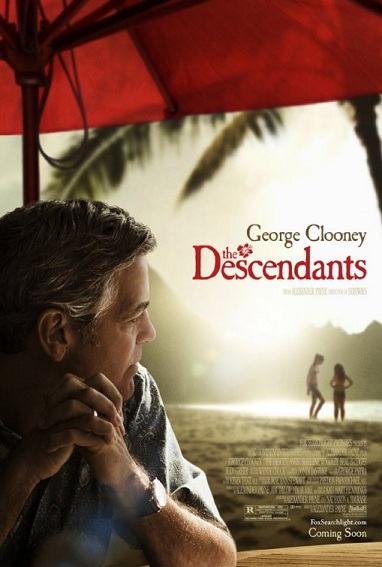
Director Alexander Payne has been making great films since Citizen Ruth and Election, but chances are most people are more familiar with Sideways or About Schmidt due to their Oscar nominations. His new film, The Descendants, shares a tone and subtlety with those latter films, to the point where those with shorter attention spans may flee the theater for the latest Twilight saga. I prefer to think of it as playing on Hawaii time, since the film is set completely among the non-tourists of that laid-back paradise.
The Descendants is gorgeously shot and deceptively subversive in the way that it confronts non-native people's co-opting of sacred lands. It won't make you feel bad as you sip a pina colada at a Hawaiian resort, but then again, it might.
George Clooney plays Matt King, a rich lawyer who is a direct descendent of Hawaiian royalty, which makes him executor of a trust that includes hundreds of acres of pristine Hawaiian land that he must sell before the laws dissolve the agreement. Unlike his family of Jimmy Buffett-like cousins, he hasn't lived off the great wealth the trust provided, and he is more than a little conflicted about selling the land for development.
All of this is just a backdrop to what is happening in his life. His wife, Barbara, bored by his lack of attention, began "seizing life" and ended up in a coma from a speedboat accident. Now forced to be a full-time father, Matt doesn't know how to communicate with his younger daughter and has no idea that his older daughter is getting drunk at the pricey boarding school where he sent her to straighten up.
The majority of the film deals with Barbara's imminent death and how to prepare the family and friends, while Clooney's character must additionally deal with a shattering betrayal by his now-comatose wife. Clooney gives a terrific, nuanced performance that is especially heartbreaking when he is left alone in the hospital room with his duplicitous wife and has to make peace with her. He gradually learns through tragic and uplifting events how to reconnect with his daughters and with the great land with which he has been entrusted.
Actress Shailene Woodley, who is best known for her role in The Secret Life of the American Teenager on ABC Family, plays the a tough, wounded daughter who becomes privy to her mother's less-than-admirable behavior in The Descendants. I recently visited with the 20-year-old actress to discuss her breakout role.
About how she got into character: "I'm not one of those actors who approaches it and thinks too much about it. I don't think about ‘the character' and ‘her arc' and what her life is like. I just try to approach it and be as present and truthful in the moment. I really responded to this screenplay because it was so real and raw and truthful and human. And it's so rare, especially in scripts that I read that are geared toward my age range. They're usually glamorized and not quite truthful."
On the screenplay: "The screenplay was so brilliantly written that there was no improvising. Emotion naturally came up and I was so fortunate to work with such phenomenal actors who gave me so much to work off of."
On director Alexander Payne, who she didn't know before she auditioned, and co-star George Clooney: "Alexander Payne is one of my top five favorite human beings on a personal level, and George Clooney is a superhuman. Every positive thing that you've read about him is true and every negative thing is hilarious because that man doesn't have a mean bone in his body.
On the time she spent on location in Hawaii: "These were the four months that shaped my young adult life. It was magical. Being there on set, it was such a comfortable environment. George was never in his trailer, he was always there hanging out with us. No one was better than anyone else and Alexander is such a happy human being, he created such a happy environment, there were never any fights or any disputes."
On the films serious and funny moments: "Everyone in some way or another has to deal with death, whether it's someone close or a family member, and at the same time, this movie is very funny. Life is funny, and we as human beings are hilarious. My friends who are gay always seem more open and comfortable with life and with mistakes. I took one of my friends to see the film and he was crying through half the film and laughing through the other half. Afterwards, he said, ‘That's just like real life: you laugh, you cry and you don't realize how funny life can be until you remove yourself from the bubble and look back on it.'"
Review and interview by Neil Cohen, resident film critic of Movie Dearest and Phoenix's Echo Magazine.
The Descendants is gorgeously shot and deceptively subversive in the way that it confronts non-native people's co-opting of sacred lands. It won't make you feel bad as you sip a pina colada at a Hawaiian resort, but then again, it might.
George Clooney plays Matt King, a rich lawyer who is a direct descendent of Hawaiian royalty, which makes him executor of a trust that includes hundreds of acres of pristine Hawaiian land that he must sell before the laws dissolve the agreement. Unlike his family of Jimmy Buffett-like cousins, he hasn't lived off the great wealth the trust provided, and he is more than a little conflicted about selling the land for development.
All of this is just a backdrop to what is happening in his life. His wife, Barbara, bored by his lack of attention, began "seizing life" and ended up in a coma from a speedboat accident. Now forced to be a full-time father, Matt doesn't know how to communicate with his younger daughter and has no idea that his older daughter is getting drunk at the pricey boarding school where he sent her to straighten up.
The majority of the film deals with Barbara's imminent death and how to prepare the family and friends, while Clooney's character must additionally deal with a shattering betrayal by his now-comatose wife. Clooney gives a terrific, nuanced performance that is especially heartbreaking when he is left alone in the hospital room with his duplicitous wife and has to make peace with her. He gradually learns through tragic and uplifting events how to reconnect with his daughters and with the great land with which he has been entrusted.
Actress Shailene Woodley, who is best known for her role in The Secret Life of the American Teenager on ABC Family, plays the a tough, wounded daughter who becomes privy to her mother's less-than-admirable behavior in The Descendants. I recently visited with the 20-year-old actress to discuss her breakout role.
About how she got into character: "I'm not one of those actors who approaches it and thinks too much about it. I don't think about ‘the character' and ‘her arc' and what her life is like. I just try to approach it and be as present and truthful in the moment. I really responded to this screenplay because it was so real and raw and truthful and human. And it's so rare, especially in scripts that I read that are geared toward my age range. They're usually glamorized and not quite truthful."
On the screenplay: "The screenplay was so brilliantly written that there was no improvising. Emotion naturally came up and I was so fortunate to work with such phenomenal actors who gave me so much to work off of."
On director Alexander Payne, who she didn't know before she auditioned, and co-star George Clooney: "Alexander Payne is one of my top five favorite human beings on a personal level, and George Clooney is a superhuman. Every positive thing that you've read about him is true and every negative thing is hilarious because that man doesn't have a mean bone in his body.
On the time she spent on location in Hawaii: "These were the four months that shaped my young adult life. It was magical. Being there on set, it was such a comfortable environment. George was never in his trailer, he was always there hanging out with us. No one was better than anyone else and Alexander is such a happy human being, he created such a happy environment, there were never any fights or any disputes."
On the films serious and funny moments: "Everyone in some way or another has to deal with death, whether it's someone close or a family member, and at the same time, this movie is very funny. Life is funny, and we as human beings are hilarious. My friends who are gay always seem more open and comfortable with life and with mistakes. I took one of my friends to see the film and he was crying through half the film and laughing through the other half. Afterwards, he said, ‘That's just like real life: you laugh, you cry and you don't realize how funny life can be until you remove yourself from the bubble and look back on it.'"
Review and interview by Neil Cohen, resident film critic of Movie Dearest and Phoenix's Echo Magazine.
Sunday, November 27, 2011
Reverend's Report: Returns to Oz
Wicked, the lavish stage production based on a 1995 novel by gay author Gregory Maguire and featuring songs by Oscar-winning composer Stephen Schwartz, remains the top-grossing musical on Broadway eight years after its opening and has been a massive hit on tour. It returns to the Pantages Theatre in Los Angeles in late November for a month-long run.
Author L. Frank Baum originally introduced us to the magical world of Oz in 1900. His initial novel, The Wonderful Wizard of Oz (the first of 14 books set in Oz that he penned), was subsequently turned into a 1902 stage musical as well as the classic film of 1939 starring Judy Garland. A non-musical (and underrated, in my opinion) movie sequel, Return to Oz, was released by Walt Disney Pictures in 1985 and quickly flopped at the box office. Now, Disney is trying again with a new film, Oz: The Great and Powerful, scheduled for release in 2013. It stars gay-friendly "it" boy James Franco in the title role and is being directed by Sam Raimi of the Evil Dead and Spider-Man series.
Despite attempts by Disney and others to put Oz's ruling wizard front and center, it has long been the saga's women who have captured the public imagination. Whether they be the young Kansas farm girl Dorothy, unexpectedly transported to the land "over the rainbow" by a powerful tornado, or an assortment of witches both good and bad (played by the unforgettable Margaret Hamilton and Billie Burke in The Wizard of Oz as well as Michelle Williams, Rachel Weisz and Mila Kunis in the new production), the women of Oz continue to command attention.
Wicked is no exception. The stage musical, which is also slated for eventual adaptation into a movie by Universal Studios, recounts the story of how the prickly, green-skinned Elphaba first met and befriended the vacuous but saintly Galinda. Whereas the former would become best known in Oz as "the Wicked Witch of the West," Galinda (nee "Glinda") ultimately became identified along with Dorothy as its savior. Maguire's novel and the theatrical interpretation of it serve as potent political commentary, in which Elphaba is revealed as having good intentions while the Wizard plots to subjugate the citizens of Oz to his self-serving will.
The Oz books, movies and musicals have long held special relevance for GLBT people. I believe this is because we identify with the heroic journeys undertaken by Elphaba and Dorothy in leaving home, discovering their self worth and special/magical attributes, and ultimately helping others with the wisdom they have gained. As we mature in the GLBT community, our personal journeys often undergo a similar process.
In addition to the return of Wicked, two new books have recently been published that continue to explore the lessons we can gain from Oz and its inhabitants. Now available is And Toto Too: The Wizard of Oz - A Spiritual Journey.
Written by Nathan Castle, a Dominican priest, it has been recommended by Rabbi Barton G. Lee as "of interest to all who ponder questions about God, ethics, and life's meaning(s) whatever their own religious background." And Maguire's fourth and final novel in his popular Wicked series, Out of Oz,
was also released recently.
Clearly, the land of Oz continues to cast a magic spell through a variety of media more than a century since L. Frank Baum dreamed it up.
Report by Rev. Chris Carpenter, resident film critic of Movie Dearest and the Blade California.
Author L. Frank Baum originally introduced us to the magical world of Oz in 1900. His initial novel, The Wonderful Wizard of Oz (the first of 14 books set in Oz that he penned), was subsequently turned into a 1902 stage musical as well as the classic film of 1939 starring Judy Garland. A non-musical (and underrated, in my opinion) movie sequel, Return to Oz, was released by Walt Disney Pictures in 1985 and quickly flopped at the box office. Now, Disney is trying again with a new film, Oz: The Great and Powerful, scheduled for release in 2013. It stars gay-friendly "it" boy James Franco in the title role and is being directed by Sam Raimi of the Evil Dead and Spider-Man series.
Despite attempts by Disney and others to put Oz's ruling wizard front and center, it has long been the saga's women who have captured the public imagination. Whether they be the young Kansas farm girl Dorothy, unexpectedly transported to the land "over the rainbow" by a powerful tornado, or an assortment of witches both good and bad (played by the unforgettable Margaret Hamilton and Billie Burke in The Wizard of Oz as well as Michelle Williams, Rachel Weisz and Mila Kunis in the new production), the women of Oz continue to command attention.
Wicked is no exception. The stage musical, which is also slated for eventual adaptation into a movie by Universal Studios, recounts the story of how the prickly, green-skinned Elphaba first met and befriended the vacuous but saintly Galinda. Whereas the former would become best known in Oz as "the Wicked Witch of the West," Galinda (nee "Glinda") ultimately became identified along with Dorothy as its savior. Maguire's novel and the theatrical interpretation of it serve as potent political commentary, in which Elphaba is revealed as having good intentions while the Wizard plots to subjugate the citizens of Oz to his self-serving will.
The Oz books, movies and musicals have long held special relevance for GLBT people. I believe this is because we identify with the heroic journeys undertaken by Elphaba and Dorothy in leaving home, discovering their self worth and special/magical attributes, and ultimately helping others with the wisdom they have gained. As we mature in the GLBT community, our personal journeys often undergo a similar process.
In addition to the return of Wicked, two new books have recently been published that continue to explore the lessons we can gain from Oz and its inhabitants. Now available is And Toto Too: The Wizard of Oz - A Spiritual Journey.
Clearly, the land of Oz continues to cast a magic spell through a variety of media more than a century since L. Frank Baum dreamed it up.
Report by Rev. Chris Carpenter, resident film critic of Movie Dearest and the Blade California.
Subscribe to:
Posts (Atom)