Saturday, October 13, 2012

Reel Thoughts: Covert Arts


With unprecedented saber-rattling by the Right Wing and End-of-Days predictions about an Iran-based war swirling about, not to mention the disturbing attack on the US Embassy in Libya, Ben Affleck’s enthralling new film Argo takes on a whole new level of significance. After all, how will movie-goers react to seeing Iranian protestors attack and take over the US Embassy in Tehran, taking and abusing the hostages while six employees who escaped are trapped in the British Ambassador’s residence as the Iranian authorities search for them?

Argo is based on the fascinating true story of how a CIA hostage extractor managed to get the Iranian government to allow him into the country thinking that he was a schlocky sci-fi movie director. Once there, his plan was to get the six embassy workers out of Iran by posing as his location scouting crew. Affleck just gets better and better as a director, as he leaves his Boston comfort zone of Gone Baby Gone and The Town for 1979 Iran, DC and Hollywood. Affleck gets the Carter-era period perfect, right down to the horrible hairstyles and even worse clothes. He doesn’t demonize the Iranians any more than they probably deserve based on their actions, and he keeps the action and suspense palpable, even though you may remember or can guess how the mission will work out.
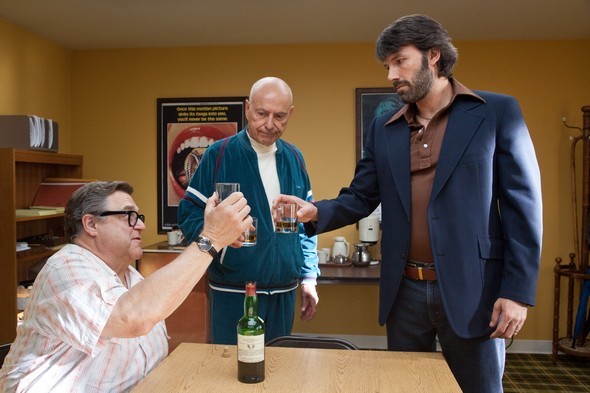

While fifty-two hostages remained prisoners for 444 days, ending only on Ronald Reagan’s inauguration day in 1981, the six diplomats who found refuge with Canadian Ambassador Ken Taylor (Victor Garber), had no idea from day to day whether or not they would be found out and subsequently killed. Back in the US, CIA “exfiltration expert” Tony Mendez (Affleck) hit upon an idea so crazy it had to work. Posing as a movie producer and enlisting the help of a Hollywood mogul (Alan Arkin) and make-up guru (John Goodman), Mendez concocts the production of Argo, a Star Wars rip-off that had to be everything but filmed in order to fool the Iranians. With doctored Canadian passports, Mendez was allowed fairly free access to “scout locations” with his team, all of whom were actually the trapped diplomats posing as the screenwriter, director, costume designer, etc. It was very dangerous, and Argo works best when the terrified diplomats are forced to go out in plain sight to prove their stories.

Affleck and Brian Cranston are terrific as the CIA’s finest, while the trapped Americans disappear into their roles perfectly. Try to pick out Clea Duval (But I’m a Cheerleader) or Tate Donovan (Disney’s Hercules). Arkin and Goodman bring much-appreciated humor to the dark adventure, but it is the story that keeps you intrigued. American actions by President Carter threaten to blow the operation, but Argo is a rousing adventure docudrama that earns its thrills. By the end, you are almost sorry that we never saw the actual movie “Argo” on screen.

But, as Arkin’s Lester Siegel says to a nosy reporter who asks him what Argo is about, he replies “Ar-go f*** yourself!”

Review by Neil Cohen, resident film critic of Movie Dearest and Phoenix's Echo Magazine.

Thursday, October 11, 2012

Reverend’s Reviews: Music of the Heart

Georges and Anne are 80-something, retired music teachers.  They live in a comfortable Parisian apartment and are sincerely enjoying one another and their “golden years” together.  But when Anne’s health suddenly starts to decline, the true test of the couple’s love begins.

Amour, winner of the Palme D’Or at this year’s Cannes Film Festival and Austria’s entry in the 85th annual Academy Awards, won’t open in the US until just before Christmas, but Los Angeles-area members of the press were recently treated to early screenings.  The latest work by acclaimed writer-director Michael Haneke (who was previously honored at Cannes for his films The White Ribbon, Cache and The Piano Teacher) is a thoughtful, unsentimental — though not unfeelingexamination of long-term romantic commitment.  Leave your rose-tinted glasses at the door.

As husband and wife as well as teachers and parents to their professional-musician daughter (played by Isabelle Huppert), Georges (Jean-Louis Trintignant, veteran of over 100 films including such classics as A Man and a Woman, Z and The Conformist) and Anne (the utterly heartbreaking Emmanuelle Riva) have given life their all.  As is typically the case for all of us, however, they don’t begin to fully realize the quality and value of their relationship until it becomes clear that it is coming to an end. 


Anne has a mini-stroke one morning during breakfast, which is followed soon after by a more severe event.  Partly paralyzed as a result and requiring more and more assistance from Georges as time goes on, we watch as Anne becomes utterly dependent and, ultimately, unable even to communicate intelligibly.  Georges and their daughter struggle with their own helplessness as they strive to accept Anne's impending death.  As far as plot goes, that's about it.

I found Amour stunning, in a good way.  As I posted simply on Facebook immediately after seeing it: “Wow.”  It is a near-perfect movie (a couple of horror movie-ish nightmares Georges has are Haneke's only missteps) that deals so well and sensitively with aging, facing death, relationships and, yes, love.  My inner moral theologian questions a startling plot development late in the film, but it is a fairly minimal concern in light of Georges' devotion to his wife.  Trintignant and Riva are seriously deserving of Academy Awards consideration and I really hope they are nominated.

Given the characters' professional background, it is only appropriate that music play a fairly large part in Amour.  Much of it is provided by French pianist Alexandre Tharaud, who makes his acting debut in the film as Anne's star pupil (appropriately named Alexandre).  He provides lovely interpretations of Bach, Chopin and Ravel here that serve as at times joyous, at times mournful soundtrack.  As the film illustrates so elegantly and movingly, the music of love has many shades.


Conversely, director Andrea Arnold (Fish Tank) forgoes music entirely in her new adaptation of Wuthering Heights (now playing in New York City and opening in LA tomorrow), save for an occasional hymn sung by the actors and an end titles song performed by current country-folk sensation Mumford & Sons.  Arnold's approach to Emily Bronte's classic, 19th-century saga of tortured romance emphasizes the natural sounds of its remote setting.  The result is visceral, at times savagely so, as Arnold removes virtually all the costume drama artifice that has adorned prior film versions.

For those unfamiliar with the story, it chiefly concerns the love of Heathcliff, a poor orphan living in the Liverpool streets, for Catherine, the daughter of a well-intentioned Christian farmer who takes Heathcliff in.  Though Heathcliff is treated as little more than a servant by most in the household, Catherine also develops feelings for him.  Alas, Catherine eventually decides to marry a wealthier man, breaking Heathcliff's heart but setting him on a years-long quest to prove himself worthy of her.

Arnold also made the bold artistic choice to cast a pair of black actors as younger and older Heathcliff.  Though the lad was described by Bronte as having dark skin, Heathcliff has traditionally been played by the caucasian likes of Laurence Olivier, Timothy Dalton, Ralph Fiennes and Tom Hardy.  Newcomers Solomon Glave and James Howson are excellent here, and the camera loves them (Of note, Wuthering Heights won the Best Cinematography award at the 2011 Venice Film Festival; it is also somewhat curiously shot in full-screen/non-widescreen format).  The remainder of the largely non-professional cast makes less of an impression, though the performances of all concerned are acceptable.


Making Heathcliff unquestionably black naturally adds a layer of racial tension to the story, which gets awkward at times when white characters hurl the decidedly non-Bronte "N-word" at Heathcliff.  Similarly, Heathcliff uses modern vulgarities at one point to describe his oppressors.  Arnold also heightens the sexual tension and content in ways that I'm not sure Bronte would approve of.  Such license serves to diminish the characters rather than bring any greater understanding or appreciation of them to today's audiences.

Despite the director's interesting take on this classic work of literature, I'll stick with the revered 1939 movie version that starred Olivier and Merle Oberon, even though it took its own liberties with the source material.  Notably, it only covers the first half of Bronte's book and therefore ends on a much less tragic note.

Reverend’s Ratings:
Amour: A-
Wuthering Heights: C+

Review by Rev. Chris Carpenter, resident film critic of Movie Dearest and Rage Monthly Magazine.

Wednesday, October 10, 2012

Reverend’s Reviews: The President and The Spy

This presidential election season has already given Americans plenty to laugh — and cry — about.  Los Angeles’ Center Theatre Group is weighing in with their local premiere production of David Mamet’s 2007 satire, November.  Now running at the Mark Taper Forum through November 4th, it is a scattershot but frequently amusing work… so long as one can tolerate Mamet’s generous use of the F-word.

Ed Begley, Jr. headlines the LA production as President Charles “Chuck” Smith.  As Smith’s failed first term is drawing to a close, he’s less interested in being re-elected than in ensuring he has enough cash with which to build and furnish an impressive presidential library.  When Smith learns he only has $4,000 in his library fund, he begins to concoct far-fetched fundraising schemes with the help of his closest advisor, Archer Brown (played by Rod McLachlan).  Their most immediate target becomes the National Association of Turkey and Turkey By-Products Manufacturers, whose chief representative (the very funny Todd Weeks) happens to be waiting at the moment outside the Oval Office along with two turkeys waiting to be pardoned for Thanksgiving.
   
Smith also enlists the help of his longtime speechwriter, Clarice Bernstein (former Desperate Housewife and Transamerica Oscar nominee Felicity Huffman), to craft an alternate Thanksgiving Day mascot and menu item should the turkey rep fail to meet the President’s extortionist demands.  Bernstein is an out lesbian who has just returned with her partner from a trip to China, where the pair adopted a baby girl.  She also may have brought back an infection with highly-contagious bird flu.


While November is full of ripe ingredients for an effective satire, Mamet’s dish ultimately feels under-baked.  The cast works hard (especially Begley, who suffered a frog in his throat and some resultant poor delivery during his first scene on opening night but triumphed through the remainder of the performance) and Takeshi Kata’s Oval Office set is excellent, but too much of the play’s humor is dependent on unoriginal swipes at Jews, the Chinese and, yes, GLBT people.  Huffman is a hoot in the final scene, wherein she sashays about in a lavish wedding dress waiting for the President to marry her and her partner on national television (an arrangement she has herself extorted), and the play ends up taking a strong stance for same-sex marriage.  GLBT members of the audience, however, have to endure more than a few references to gay love as “disgusting” and “unnatural” along the way.

November is minor Mamet and hardly a play for the ages, unlike most of his other works.  If the satirically-minded among us aren’t getting enough kicks out of the current debates, though, this big-name LA production may be just the ticket to comedy heaven.


Speaking of presidential elections, the last time a James Bond adventure hit the big screen was just after Barack Obama's victory in 2008.  Now, 50 years after the debut of Dr. No -- the first feature movie adapted from one of Ian Fleming's classic novels -- and just prior to next month's premiere of the Sam Mendes-directed Skyfall, there is a terrific new documentary detailing the long-running film series' history.  Everything or Nothing: The Untold Story of 007 is now playing theatrically in the UK and on the EPIX satellite channel here in the US.

Writer-director Stevan Riley (Fire in Babylon, Rave Against the Machine) expertly distills five decades' worth of backstage and onscreen drama into 98 rapid-fire minutes.  He incorporates interviews with Fleming and those who knew him, including distant cousin and horror film star Christopher Lee, who played the villain Scaramanga in The Man with the Golden Gun; footage from Fleming's home movies; snippets from the 22 Bond features; and, most effectively, excerpts from the various Bond movie scores as the documentary's soundtrack.

"Fleming put his own struggles on the page," says current Bond Daniel Craig, while another commentator refers to the British superspy's creator as "a man of infinite contradictions."  Whereas Bond actually made his first appearance off the page in an American (and Americanized) TV adaptation of Casino Royale, it was producers Albert "Cubby" Broccoli and former circus showman Harry Saltzman who transferred Bond to the silver screen in 1962, and in the iconic form of Sean Connery.


Everything or Nothing (which was Broccoli's and Saltzman's motto as producers, the initials of whichEONcomposed the name of their production company) recounts the Connery years, as well as the one-time appearance of George Lazenby in the role.  Lazenby gives a great interview in the doc, during which he reveals that he had to convince Broccoli and Saltman he wasn't gay since his only prior experience on camera was as a male model.  Subsequent Bonds Roger Moore, Timothy Dalton and Pierce Brosnan also give illuminating interviews.  

Saltzman eventually had to sell his share in the franchise in order to pay off debts, which made Broccoli the sole proprietor behind the Bond films from 1976 until his death twenty years later.  His daughter, Barbara, and son-in-law Michael Wilson are the current custodians of the Bond name.  "Cubby," Wilson states, "never took the audience for granted."  This shows, I believe, in the series' remarkable consistency and endurance.

Moore's last appearance as Bond in 1985's A View to a Kill is strangely omitted, but Everything or Nothing is otherwise a thoroughly, captivatingly comprehensive tour of 50 years of cinema and cultural history.  It's also one of the best, most uniquely crafted documentaries I've seen this year.

Reverend’s Ratings:
November: B
Everything or Nothing: A-
Review by Rev. Chris Carpenter, resident film critic of Movie Dearest and Rage Monthly Magazine.

Monday, October 8, 2012

Reel Thoughts: Preaching to the Choir

Pitch Perfect takes place at Barden College, a gorgeous old Ivy League-style school that is Ground Zero for nationally recognized a cappella choirs. The ruling kings are the obnoxious Treble Makers, run by douchebag Bumper (Adam DeVine), while the women’s group, The Bellas, are regrouping after an embarrassing projectile vomiting incident at Lincoln Center. Anna Kendrick plays Beca, a sullen wannabe DJ who is attending Barden as a bribe from her professor father. Barden is a college straight out of Glee-land, which means that Beca’s fabulous but undiscovered singing voice won’t be secret for long.

In a fairly homoerotic meet-cute scene, Beca is cajoled by Chloe (Hairspray's Brittany Snow, now a redhead) into trying out for the Bellas while naked in the co-ed showers. Beca immediately butts heads with uptight and vomit-prone Aubrey (Anna Camp, making a big impression) over how old-fashioned the Bellas’ song list is (Ace of Base and the Bangles? Check!). Meanwhile, Beca starts warming up to good guy Jesse, played by Hamlet 2 and Spring Awakening performer Skyler Astin, who ends up in the Treblemakers. Meanwhile, the Bellas under Aubrey’s leadership has to make do with a ragtag bunch of quirky girls, including an almost mute pyromaniac named Lilly (Hana Mae Lee), a fierce lesbian named Cynthia Rose (Ester Dean) and the self-nicknamed Fat Amy, played by Aussie Rebel Wilson (who is in every movie this year, it seems).


“Aca-scuse me?” Aubrey says early in the film, and it's the last time that joke will be used. Pitch Perfect is directed by Avenue Q director Jason Moore and it has a cheeky attitude that yields a lot of laughs. The musical numbers are fun, and the cast is great. At the same time, Pitch Perfect can go flat when they push the humor too hard, and it isn’t as sharp as it could have been.

Fans of Christopher Guest films like Best in Show will enjoy producer (and Hunger Games actress) Elizabeth Banks and John Michael Higgins as wisecracking commentators on the National Collegiate A Cappella circuit. While Pitch Perfect isn’t perfect by any means, it is a fun and campy change of pace at the multiplex.

Review by Neil Cohen, resident film critic of Movie Dearest and Phoenix's Echo Magazine.