Friday, November 6, 2020

Reverend's Reviews: Giving Thanks for New LGBTQ Movies


Ah, November has arrived. The month of cooler temperatures, roasted turkeys and pumpkin pies is here! Unfortunately, traditional Thanksgiving gatherings will be impacted by the ongoing COVID-19 prevention efforts. But November remains the start of the holiday season as well as the film industry's annual awards season.

Due to pandemic-related delays, awards season will last longer than usual this year. The current submission and screening deadline for most organizations including the Academy of Motion Picture Arts & Sciences is the end of February 2021, with most awards not being presented until March or April. Three new movies of gay, bi and/or queer interest that are also sparking awards buzz are therefore getting a head start by being released this month. They will play theatrically where possible but will also be available for streaming.

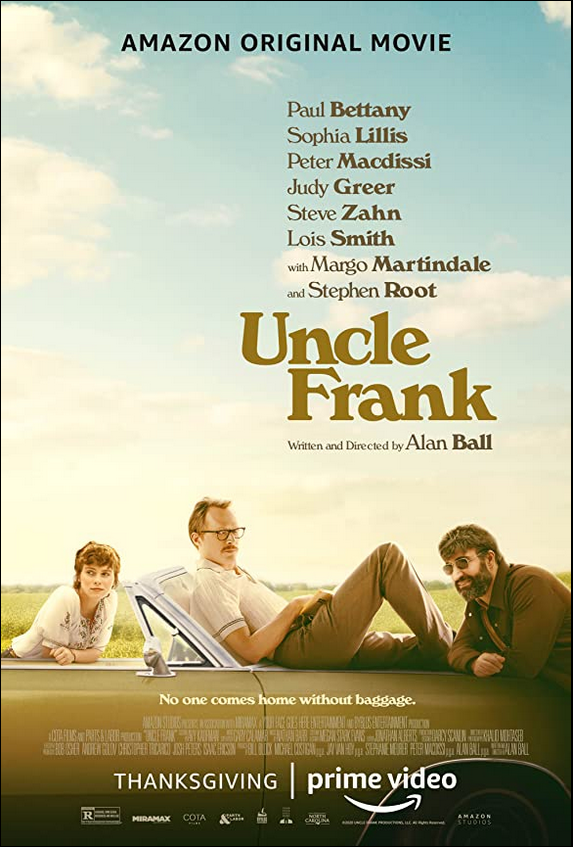
Uncle Frank, from Amazon Studios, is a nostalgic and often heartrending look at the life of a closeted gay man in the early 1970's. It will be available on Amazon Prime beginning November 25th. British actor Paul Bettany, best known as the heroic Vision in various Marvel Universe epics, could be an awards contender for his sensitive performance in the title role. Following his upbringing in conservative South Carolina, Frank has fled to New York City and become a revered literature professor. He also has a longtime but secret partner, Walid, who is warmly portrayed by Peter Macdissi.

Things start to get complicated for Frank when his young niece, Beth (Sophia Lillis, who made a splash as Beverly in the It movies), becomes a student on his NYU campus. She soon discovers that her beloved uncle is gay but accepts him. Things get much more complicated when they receive word of the sudden death of Frank's homophobic father, Beth’s grandfather. Frank, a recovering but vulnerable alcoholic, reluctantly returns home for the funeral with Beth in tow. They undertake a road trip to Creekville, SC, which Walid unexpectedly but eventually joins them on.

Once home, Frank learns he was excluded from his late father's will and, to make matters worse, is forced to finally face a long-buried trauma that he has spent his entire adult life running away from. Many gay men of his generation will be able to relate to this aspect of the script, which was written by Alan Ball. Ball is the out and well-respected creator of TV's Six Feet Under and True Blood, and he won an Oscar for his original screenplay for American Beauty. He also directed Uncle Frank and served as one of its producers.

In addition to providing a great acting showcase for Bettany, the film's excellent supporting cast includes Judy Greer, Steve Zahn and Margo Martindale plus stage and screen veteran Lois Smith, who turns 90 this month. It also features plenty of humor despite its serious subject matter, including the hilarious line: "I'll slap you so hard, your clothes will go out of style!" Uncle Frank should not be missed.


Another new queer release set in the early 1970's is Stardust, a biopic about singer David Bowie's challenging transformation into his androgynous alter ego, Ziggy Stardust. It will also be released on November 25th by IFC Films. Johnny Flynn, who also made an impression in Emma earlier this year, is eerily evocative as young Bowie. He nails the late performer's appearance, voice and mannerisms. Knowing how the Academy loves actors who play musical icons (see Renee Zellweger, who won last year for Judy, and Rami Malek's win as Freddie Mercury the previous year, among many others), Flynn could be a contender for Best Actor this year.

Stardust opens with Bowie's arrival in the United States for the first time in 1971. Although Bowie was popular in Europe, he wasn't yet a name here due to his music being, as described by his manager in the film, "too dark, too weird for the Yanks." He is surprised to discover upon his arrival that his manager failed to arrange the proper visa for him. What Bowie thought was going to be a national singing tour turned out to be a series of radio interviews in largely rural areas that proved less than welcoming.

Bowie was known early on for his gender fluidity in terms of how he dressed, and he came out as bisexual to Playboy magazine in 1976. While Stardust doesn't delve into his sexuality much apart from his open marriage at the time to Angie Barnett (played by Jena Malone), he does decry "bourgeois morality" and is shown as being anything but conventional. Costume designer Julia Patkos does a fabulous job in this regard, re-creating Bowie's outfits and the general fashions of the time.

According to the film, several of Bowie's family members suffered from schizophrenia, including his older brother. He is depicted as terrified of being diagnosed as schizophrenic himself. This fear is what ultimately drove him to develop his Ziggy Stardust persona, who Bowie could separate from himself. The move paid off, making Bowie famous both nationally and internationally. It also led to him becoming an impressive actor in movies and theatre.

Stardust provides considerable insight into Bowie, who died much too soon in 2016. His fans, general music fans, bisexual men and queer viewers will find much to appreciate in the film.


Monsoon is a modern-day story that has already been an awards contender. It will be available from Strand Releasing on November 13th. Cambodian writer-director Hong Khaou's reflective drama was nominated for Best Picture in 2019 at both the Athens International Film Festival and Karlovy Vary International Film Festival. It has been well received this year at Outfest, NewFest and other LGBTQ film festivals here in the US.

The very hot Henry Golding of Crazy Rich Asians fame plays Kit, a gay British-Vietnamese man. He returns to Saigon from London for the first time since he was six years old, when his family fled the country in the aftermath of the Vietnam-American war. Sadly, he has come home to lay his late mother's ashes to rest. He re-connects there with Lee, his estranged second cousin, and arranges an online date that turns into something more with Lewis (Parker Sawyers, who previously played a young Barack Obama in Southside With You). Lewis is a sexy clothing designer preparing to open his first shop in Vietnam. As Kit struggles to make sense of himself in a country he's no longer familiar with, hooking up with some other men along the way, his personal journey opens up new possibilities for friendship, love and happiness.

Khaou's perceptive screenplay tackles many issues in a generally subtle way. These include enduring conflicts between the East and West including acceptance (or not) of different sexual orientations, as well as racial and generational differences. John Cummings' striking music score also deserves mention. Monsoon emerges as an intelligent and touching film, well worth watching after a hearty Thanksgiving dinner.


Although it doesn't have any LGBTQ content, the amazing Shadow in the Cloud has two other things going for it: gremlins and Chloƫ Grace Moretz. It is also an unquestionably feminist suspense-adventure film. I caught its North American premiere during last month's online AFI Film Festival and I am so glad I did! This New Zealand production directed by Roseanne Liang is one of the most genuinely exciting and entertaining films I've seen in several years.

Gremlins haven't been seen on movie screens since the 1984 classic bearing the mischievous creatures' name. Prior to that, they were primarily known for their memorable appearance in the original Twilight Zone TV series and its 1983 movie adaptation. But prior to that, they were to blame by World War II pilots for any mishaps that occurred with their planes during flight.

Shadow in the Cloud goes back to the source of this aviation legend. Moretz (Kick-Ass, Hugo, Greta) plays Maude Garrett, an alleged military officer with more than a few secrets who is assigned to a flight aboard the aptly-named "Fool's Errand" carrying a top-secret package. As the only female on board, the plane's crew of male chauvinists make her sit alone in one of the gun turrets.

It isn't long before Maude finds herself face to face – literally – with a human-sized, bat-like creature hellbent on tearing the plane apart. Naturally, the men above don't believe her until the gremlin starts picking them off one by one. The action becomes increasingly, deliriously over the top as Maude extricates herself and takes charge. The camera rarely leaves Moretz, and she makes Maude the fiercest movie heroine since Sigourney Weaver's Ellen Ripley in the Alien series! This is not hyperbole.

Written by Max Landis (son of director John Landis), Shadow in the Cloud features solid performances all around as well as terrific special effects and an awesome, retro 80's music score by Mahuia Bridgman-Cooper that does John Carpenter and his frequent collaborator Alan Howarth proud. I loooove this movie and hope it gets a US release soon!


It's hard to believe that Requiem for a Dream is 20 years old. Darren Aronofsky's horrific yet poetic adaptation of Hubert Selby Jr's novel about how addiction sabotages four people's pursuit of their dreams was released last month on an anniversary-edition 4K Ultra HD and Blu-ray combo pack for the first time, courtesy of Lionsgate. This hi def transfer makes the film and Matthew Libatique's cinematography that much more vivid.

For me, the heartbreaking highlight of the movie remains Ellen Burstyn's Oscar-nominated performance as Sara Goldfarb, a widowed woman yearning for recognition late in life. This leads her to first develop an addiction to television and then on "upper" diet pills. A young Jared Leto plays her heroin junkie son, with Jennifer Connelly and Marlon Wayans in fine form as his doomed friends. It is not a pretty nor uplifting picture but talent shines throughout both on screen and behind the scenes.

New special features on this home video release include audio commentaries by Aronofsky and Libatique, an interview of Burstyn, deleted scenes and a featurette on the film's memorable music score by Clint Mansell and Kronos Quartet (which sounds especially good in this transfer's Dolby Atmos sound mix). While not for the faint of heart, Requiem for a Dream endures as a cautionary classic.

Reverend's Ratings:
Uncle Frank: B
Stardust: B+
Monsoon: A-
Shadow in the Cloud: A
Requiem for a Dream (20th anniversary home video release): B+

Reviews by Rev. Chris Carpenter, resident film and stage critic of Movie Dearest and Rage Monthly Magazine.

Monday, October 12, 2020

Reverend's Preview: SDIFF 2020: Virtual But Not Silent


We can add this month's San Diego International Film Festival (SDIFF) to the ever-growing list of events that have had to largely go the streaming route this year due to the COVID-19 pandemic. Uniquely though, the fest will still be providing opportunities for film fans to gather together in safe, socially-distanced ways at its first-ever "Virtual Village."

This re-imagined, COVID-appropriate 2020 San Diego International Film Festival will take place October 15th-18th. As the region’s premier film festival and one of the leading stops on the independent film circuit, film lovers can enjoy 114 features, documentaries and short films online in the Virtual Village and on the big screen at the Festival Drive-In Movies at Westfield UTC. Full details as well as the complete movie lineup may be accessed at the SDIFF website.

According to Tonya Mantooth, the fest's CEO/Artistic Director: “The leadership of the San Diego International Film Festival has embraced the challenges to create a new footprint that will not only serve for this year’s festival but also expand our capabilities for the long term. This commitment to re-imagining the festival is vitally important to fulfilling our mission of presenting films that create conversation in an increasingly complex and divided world.”


SDIFF is presented by the non-profit San Diego Film Foundation, which is dedicated to creating empathy through the medium of motion pictures. The foundation leverages these important conversations via partnerships with the San Diego County Office of Education and the San Diego Unified School District, using cinematic storytelling to help educate future leaders on key issues affecting our communities and world. Their newest partnership is with the UC San Diego Extension to create a Social Impact Film Channel on the UCTV platform, which will support the "17 Sustainable Development Goals to Transform Our World" set by the United Nations. The festival will curate films from around the globe to help further understanding of these UN goals as well as inspire conversations and, most importantly, action.

"This year, we are creating space in our Virtual Village for panels around some films that examine important conversations we want to have," Mantooth revealed. "We have programmed some impactful and timely documentaries about the Civil Rights Movement. We are thrilled that Leon Clark, General Manager of Channel 10, will moderate a discussion on those documentaries for us, examining history and where we find ourselves as a country today." This sounds especially important in preparation for the upcoming US presidential election. Also to be screened are films that explore the issues of developmental disabilities, homelessness, prejudice, pollution of the world’s rivers, animal and environmental extinction, sustainability, sex trafficking and more.


Other topics to be covered are LGBTQ lives and the military, with one standout documentary incorporating both. Surviving the Silence relates a little-known story that took place years before the US Armed Forces' failed "Don’t Ask, Don’t Tell" policy, which allowed LGBTQ soldiers to serve so long as they kept their sexual orientation under wraps. Colonel Patsy Thompson was forced to expel Colonel Margarethe Cammermeyer of the US Army for being a lesbian. However, the way that Thompson – a closeted lesbian herself – presided over the discharge hearing eventually led to Cammermeyer’s re-instatement via federal court and the undoing of "Don't Ask, Don't Tell."

Cammermeyer’s memoir, Serving in Silence, was adapted as a 1995 television movie produced by Barbra Streisand and starring Glenn Close, but Thompson’s own story remained a secret. In Cindy L. Abel's new documentary, Thompson and her wife, Barbara Brass, candidly share how they wrestled with heart-wrenching choices that included hiding their relationship and struggling to protect their love while preserving Patsy's military career. They emerged to become vibrant activists later in life, with Thompson coming out to her family and the public at the age of 80. As she states in the film, she has learned "the freedom that comes with living your truth."


Prior to Surviving the Silence, Abel directed and produced the award-winning Breaking Through, a documentary in which openly-LGBTQ elected officials share their stories of self-doubt and triumph over multiple barriers. Her earlier film reveals a deeply personal, rarely seen side of both politicians and LGBTQ people. She was named “Best Filmmaker” by The Georgia Voice in 2019 and has served as National Co-Chair of the Gay & Lesbian Victory Fund, Vice-Chair of the Atlanta Film Festival, and Vice President of Communications of Women in Film & Television Atlanta.

Speaking about the inspiration behind her new documentary, Abel said "the first thing I fell in love with was (Thompson and Brass's) love story; I was fascinated that here were these women who had been together for 30 years and for much of that time had to pretend that they were not together." Abel sensitively examines each woman's personal background, which includes the fact that Brass is the Jewish daughter of two Holocaust survivors.

The highlight of Surviving the Silence is its climactic reunion of Thompson and Cammermeyer. The pair had not met since the fateful military trial in 1992. Both women admirably express their appreciation for each other 28 years later and continue to fulfill the Army motto of "duty, honor, country." This movie is a must-see.


Another LGBTQ-interest entry in this year's SDIFF is the provocative thriller, Through the Glass Darkly. A year after their daughter disappears, same-sex partners Charlie (Robyn Lively) and Angela (Bethany Anne Lind) continue to grow apart in the small town of Elrod, Georgia. When another girl goes missing, Charlie becomes convinced that the cases are connected and teams up with Amy (Shanola Hampton), a pushy reporter. This unlikely duo draws suspicion and contempt from local law enforcement but will stop at nothing to expose the town’s darkest and most devastating secrets.

Despite the current, necessary restrictions, SDIFF is taking a bold approach to what a film festival can look like in the COVID era. As Fest CEO Mantooth stated, "Film has the power to shift our perspective and allow us to look at topics through someone else’s lens. We look forward to doing a lot of that this year.”

Reviews by Rev. Chris Carpenter, resident film and stage critic of Movie Dearest and Rage Monthly Magazine.

Monday, October 5, 2020

Reverend's Reviews: Classically Queer Horror Movies


As we enter the spooky month of October, it seems there are more things to be afraid of this year than ever before! An ongoing global pandemic, an openly hostile presidential election and an unexpected opening on the Supreme Court are scary stuff indeed. Horror movies are traditionally popular in preparation for Halloween but I thought it might be more comforting, as well as more interesting, to look to the past than the present.


Monsters, ghosts and ghouls have consistently haunted movie screens since the very beginning of the film industry. One of the first was a 1910 adaptation of Frankenstein produced by inventor Thomas Edison. The Golem, The Cabinet of Dr. Caligari and Nosferatu soon followed. This last film, as well as an early version of Dr. Jekyll and Mr. Hyde titled The Head of Janus, were directed by German expressionist F.W. Murnau, who was openly gay.


In fact, there were many gay men, lesbian women and other queer artists both behind and in front of the camera for these early horror offerings. They can be considered queer in several different ways, according to Harry M. Benshoff in his book Monsters in the Closet: Homosexuality and the Horror Film (paid link). He wrote: "By 'queer,' I mean to use the word both in its everyday connotations ('questionable... suspicious... strange...') and also as how it has been theorized in recent years within academia and social politics... (it) is what opposes the binary definitions and proscriptions of a patriarchal heterosexism."

Benshoff goes on to define four ways in which a horror movie can be considered LGBTQ:
  1. The film includes identifiably LGBTQ characters;
  2. The film is written, produced, and/or directed by an LGBTQ filmmaker, even if it does not contain visibly LGBTQ characters;
  3. The film incorporates subtextual or connotative LGBTQ elements (including LGBTQ actors); and
  4. Any film viewed by an LGBTQ spectator might be considered queer due to "the queer spectator's 'gaydar,' already attuned to the possible discovery of homosexuality within the culture-at-large."

Here is a rundown of some of the most significant queer horror movies produced between 1930 and 1965:

"It's fun to stay at the Y...."
Frankenstein (1931), The Old Dark House (1932) and Bride of Frankenstein (1935):
This early trifecta of scares (though not without some welcome, knowing laughs) were all directed by the great James Whale. In 1998, Whale became the subject of gay director Bill Condon's film Gods and Monsters, which explores Whale's homosexuality in explicit detail. The handsome but closeted gay actor Colin Clive plays Dr. Frankenstein in both the original film and its sequel, and the character's relationships with his henchman Igor as well as fellow mad scientist Dr. Pretorius (wonderfully played by the bisexual Ernest Thesiger) definitely have homoerotic and/or campy shadings.

When Boris Met Bela...
The Black Cat (1934):
Horror greats Boris Karloff and Bela Lugosi co-star (for their first of eight films together) as frenemies who delight in torturing each other, both psychologically and physically. As Benshoff notes in his book, they are essentially "a sadomasochistic queer couple who dabble in all sorts of queer romance: Satanism, incest, necrophilia and bestiality." They do so in a spectacularly strange, expressionist house. The film has been assessed more recently as prefiguring the decadence and depravity of Nazi Germany.

The Hunger from Hungary
Dracula's Daughter (1936):
The stunningly beautiful Gloria Holden thrills and chills in the title role of this lesbian-leaning sequel to 1931's Dracula. Unlike most vampires, she wants to be cured of her blood-sucking condition and become "free to live as a woman." As her high-society alter ego, Hungarian Countess Zaleska, she seduces women as well as men. She also has a bitch-queen manservant who frequently comments with disdain on their shared plight as representatives of a minority.

Faster pussycat, kill, kill
Cat People (1942):
This may be my fave of the oldies, and I love its more graphically kinky 1982 remake even more. A mysterious woman, Irena (Simone Simon), with a history of difficulty with men (ahem) learns she is the descendant of a mystical race of humans who turn into panthers when they become sexually aroused. Will a handsome psychiatrist "cure" her of her deviant sexuality once he marries her in order to make love to her? While the subject matter is handled discreetly in the original, stylish director Val Lewton (who began his career as a pornographic novelist and was a nephew of lesbian actress Alla Nazimova) pushes things as far as probably any filmmaker could at the time.

Fop Culture
The Picture of Dorian Gray (1945):
The Catholic-run Hollywood Production Code of the time tried to stamp out all LGBTQ references in studio films. Nevertheless, this adaptation of Oscar Wilde's queer novel about a man whose portrait ages instead of him is the most overtly gay movie of the era. Hurd Hatfield, who was never romantically linked to women and never married, stars as Dorian, with the caustic yet debonair George Sanders co-starring as Lord Henry. They essentially play a foppish gay couple doomed by one partner's narcissism. Sound familiar?

Damn, Teenage Frankenstein was ripped...
I Was a Teenage Werewolf (1957), I Was a Teenage Frankenstein (1958) and I Married a Monster from Outer Space (1958):
Hunky young Michael Landon and Gary Conway, respectively, are both exploited by queer mad scientists in the first two films, which were big hits with the 1950's drive-in crowd. In the third, an unsuspecting young woman becomes betrothed to an alien (handsome Tom Tryon) who seeks out male members of his kind in public parks by night (double ahem). These movies are more comedic than scary by today's standards but still offer queer food for thought.

The black turtleneck proves it.
The Haunting (1963):
Adapted from queer author Shirley Jackson's The Haunting of Hill House, this was one of the scariest movies I watched as a kid and it remains effective today. Among the investigators of a ghost-infested estate is a seemingly-fearless lesbian, Theodora (played by Claire Bloom). Her sexual orientation isn't specified in the film but it doesn't have to be. A 1999 big-screen remake starring Catherine Zeta-Jones as Theodora as well as 2018's The Haunting of Hill House on Netflix have presented the character as out and proud, but they don't top the original movie when it comes to inducing goosebumps.

How many of these have you seen? This month provides a great opportunity to check them all out, especially in the absence of Halloween parties. These classic scary flicks might just provide a welcome distraction from real-life frights!

By Rev. Chris Carpenter, resident film and stage critic of Movie Dearest and Rage Monthly Magazine.

Monday, September 14, 2020

And the 2020 Dorian TV Awards Go To...


SCHITT'S CREEK
Best TV Comedy, Best LGBTQ TV Show,
Best TV Performance - Actress: Catherine O'Hara,
Best Supporting TV Performance - Actress: Annie Murphy,
Best Supporting TV Performance - Actor: Dan Levy


KILLING EVE
Best TV Drama


WATCHMEN
Best TV Movie or Limited Series,
Most Visually Striking Show


BAD EDUCATION
Best TV Performance - Actor: Hugh Jackman


92ND ACADEMY AWARDS
Best TV Musical Performance: Janelle MonƔe & Billy Porter, Opening Number


LAST WEEK TONIGHT WITH JOHN OLIVER
Best Current Affairs Program


 WHAT WE DO IN THE SHADOWS
Best Unsung TV Show


TIGER KING: MURDER, MAYHEM AND MADNESS
Campiest TV Show


DAN LEVY
Wilde Wit Award - Honoring a performer, writer or commentator whose observations both challenge and amuse


Congratulations to the winners of the 2020 Dorian TV Awards, presented by GALECA, The Society of LGBTQ Entertainment Critics (of which Movie Dearest's own Chris Carpenter and myself are members). Click here to watch all the glitz and glamour of the very first televised Dorian Award "toast" on Revry TV, a new streaming service that offers "queer TV 24/7". The special includes appearances from such "gay-list" talent as Margaret Cho, Laverne Cox, Lea DeLaria, Chad Michaels, Alex Newell, Thomas Roberts, Bruce Vilanch and more.