Showing posts with label Outfest. Show all posts

Monday, August 17, 2020

Reverend's Preview: Outfest 2020 Goes Hybrid


There are hybrid plants, hybrid animals, even hybrid cars. But a hybrid LGBTQ film festival? That's how Outfest Los Angeles is billing itself this year in light of our present, socially-distanced circumstances. LA's largest and oldest film fest, also considered the preeminent LGBTQ fest in the world, is scheduled to take place August 20th-30th.


Presented by Warner Media, Outfest 2020 will feature ten days of LGBTQ movies, panel discussions with filmmakers and celebrities, and numerous special events. It will take advantage of the latest "hybrid" opportunities in streaming/digital, at-home, and in-person (as allowed) events that will make the fest accessible to a global audience for the first time in its history. Each previous summer, Outfest has screened more than 200 feature and short films from around the world to an audience of more than 50,000 people in venues throughout Los Angeles. This year's program is being promoted as "Out Where You Are" in recognition of the current difficulty of having so many people gather together in person.

"The Outfest Los Angeles LGBTQ Film Festival was born out of an era of advocacy, understanding that the only way we would ever see ourselves reflected three-dimensionally in entertainment was if we found a way for storytellers to find visibility," according to organizers. "As the channels, audiences, and the marginalization and acceptance of our community shifts, so shall we."


Readers can visit the Outfest website for up-to-date information, as well as to purchase a full-festival online viewing pass at the low price of $59. Each film or program will be available to watch for 72 hours after its premiere. I was able to preview several features to be screened including Cured, which will be making its world premiere on August 24th. This eye-opening documentary is directed by Bennett Singer (Brother Outsider: The Life of Bayard Rustin) and Patrick Sammon (Codebreaker), and was co-produced by Outfest's former Executive Director, Christopher Racster. It illuminates a pivotal yet largely unknown chapter in the struggle for LGBTQ equality: the years-long campaign that led the American Psychiatric Association (APA) to finally remove homosexuality from its list of mental illnesses in 1973.

Homosexuality was listed in the APA's first edition of "Diagnostic and Statistical Manual of Mental Disorders" (DSM) in 1952, based on limited studies of people institutionalized in prisons and psychiatric hospitals. This was subsequently used to enforce laws against LGBTQ relations, and generations of US school children were taught that being LGBTQ was "a sickness." Most psychiatrists turned a blind eye to important studies by Sigmund Freud and Alfred Kinsey arguing that homosexuality was not a mental illness.


As depicted in Cured via vintage film footage as well as more recent interviews with participants and witnesses, several pioneers in the gay rights movement saw it as essential to take on the APA. This was especially true in the wake of the Stonewall riots. As lesbian activist Barbara Gittings recognized, "Nothing would ever change as long as we were burdened with the 'sickness' label." Gittings was joined by Mattachine Society head Frank Kameny, GLAAD co-founder Ron Gold and others in storming the APA's annual meetings and demanding dialogue on the subject of homosexuality.

Despite the vociferous opposition of Dr. Charles Socarides, who remained anti-gay even after his own son came out to him, this dialogue led within a few years to the removal of homosexuality from the DSM. Ironically, Cured reveals that the current head of the APA, Dr. Saul Levin, is openly gay. The documentary serves as a strong, timely testament to the power of persistence and righteous anger to affect change.


A delightfully different, narrative movie that will also be an official selection at the fest is Dramarama. This semi-autobiographical dramedy by Jonathan Wysocki is set in Escondido at the end of summer, 1994. Five longtime friends and recent high school grads gather for an overnight Victorian murder-mystery party before heading their separate ways to college. The fact that all of them were involved in theatre together adds a hilariously over-the-top element to the proceedings.

Among this group of three girls and two boys is the closeted Gene, who is questioning not only his sexuality but his faith. He is attracted to his best friend, Oscar, as well as a local pizza delivery guy. Tensions, sexual and otherwise, bubble up throughout the friends' final night together. Dramarama is well worth seeing for Wysocki's smart script, abundant references to early-90's pop culture, a fun Danny Elfman-esque music score by Chanda Dancy, and the terrific performances given by its talented, fresh-faced cast.


Two other noteworthy films that will be screened during Outfest are Dry Wind and No Hard Feelings. "Hybrid" is a good term to describe the storytelling and/or characters in these features. Dry Wind incorporates hardcore pornography in its narrative at times, while the lead character in No Hard Feelings is often conflicted between his Iranian ethnicity but German citizenship.

Dry Wind, from Brazil, weaves a sensual tale from its Speedo-filled opening minutes to a climactic three-way. Sandro (a bold performance by Leandro Faria Lelo) is a middle-aged gay man drawn to two younger co-workers at the fertilizer plant where he works. He is also drawn to numerous fetishes including leather, motorcycles, piercings, sportswear and tattoos. Talented writer-director Daniel Nolasco references both Tom of Finland and Alfred Hitchcock in this vibrant, voyeuristic drama that features abundant full-frontal nudity and explicit gay sex.


No Hard Feelings focuses on Parvis (played by the charismatic Benny Radjaipour), a young gay man born to Iranian refugees in Hanover, Germany. After getting in some legal trouble, Parvis is assigned to complete community service hours at a local center for migrants. There he meets handsome, closeted Amon and his sister, who are both from Iran. Parvis and Amon slowly grow close to each other and embark on a genuinely sexy, ultimately tender relationship despite the threat of deportation that hangs over Amon and his sister. Faraz Shariat's admirably complex film is also a colorful, music-filled celebration of Iranian culture.

There will be many more can't-miss LGBTQ films shown during Outfest 2020, so be sure to participate from wherever you are!


If you're in the mood for some non-LGBTQ but creepy and thought-provoking sci-fi, Sputnik is newly available on demand from IFC Midnight. This Russian riff on Alien and its cinematic ilk is set in 1983 Kazakhstan while the Cold War between the USSR and US was still raging. After something goes wrong during their flight, a space capsule returns to Earth with only one survivor: the handsome commanding officer, Konstantin (Pyotr Fyodorov). Unfortunately, Konstantin claims to have amnesia and can't remember what happened.

Dr. Tatiana Klimova, a disgraced but perceptive psychiatrist well-played by Oksana Akinshina, is brought in to assess the survivor. She diagnosis Konstantin with PTSD but also discovers he has been infected by an alien parasite or symbiote that emerges from his body at night. It falls to Tatiana and the increasingly aware Konstantin to outwit their military captors, who naturally want to weaponize the creature.

Sputnik's director, Egor Abramenko, imbues the film with both a heart and conscience in addition to its accurate evocation of Soviet-era politics, science and military. While it is a creature feature on the surface, Sputnik serves as a potent allegory for the experience of being abandoned and/or adopted. It also offers a memorable twist on what might constitute a body-invading alien's main diet. The movie is gory in spots, which will please some horror/sci-fi fans, but there's more going on here.


Returning to new gay-themed films brings me to Simon Amstell's Benjamin, which will be released August 25th on DVD and VOD by Artsploitation Films. The title character, known as "Benji" to his limited friends, is a British filmmaker with a philosophical bent. He is also gay, depressed, insecure and romantically drawn to "thin boys on stage."

It is this latter trait that initially connects Benjamin and Noah, a young French singer he meets at a party. Soon after, though, Benji is confronted with the flop of his latest movie as well as his seductive (and very attractive) co-star, Harry. Will he finally grow up and become "a real boy" not unlike Pinocchio, or will Benjamin succumb to his insecurities?

Some of these plot points have been previously covered in other, better gay films but Benjamin benefits from a self-effacing sense of humor as well as good performances. Colin Morgan, perhaps best known as star of the 2008-2012 TV series Merlin, is plenty likable and at times deeply touching in Benjamin's title role. Amstell's screenplay also provides some reflective commentary on personhood and the self. Streaming the film is nothing to feel insecure about.

Reverend's Ratings:
Cured: A-
Dramarama: B+
Dry Wind: B
No Hard Feelings: B+
Sputnik: B
Benjamin: B-

Reviews by Rev. Chris Carpenter, resident film and stage critic of Movie Dearest and Rage Monthly Magazine.

Friday, August 2, 2019

Reverend's Reviews: Gay Days of Summer


The typically over-heated month of August has long been referred to as the "dog days" of summer. I have no idea why. This year, however, we can think of August as the gay days of summer based on all the LGBTQ-themed movies now in theaters, on home video, or fresh from their Outfest Los Angeles premieres.


New in select US theaters this weekend is Consequences (from Uncork'd Entertainment), which happens to be the first gay-themed narrative film from the historically conservative country of Slovenia. The attractive Matej Zemljic (who resembles CW's The Flash star Grant Gustin) plays Andrej, a troubled young man who finds himself remanded to a residential program for youths with behavioral issues.

Since the facility's counselors are largely ineffectual, Andrej finds himself drawn to his manipulative peer Zele. Zele seduces Andrej not only sexually but into his bullying lifestyle. "We're the mafia, aren't we?," Zele asks Andrej with a smile. Andrej comes to his senses and does the right thing in the end but, unfortunately, pays a price for it even as the experience leads him to embrace his sexual orientation.

Talented writer-director Darko Stante handles this subject matter sensitively but doesn't shy from the story's more brutal situations. Consequences illustrates the darker side of "What I Did for Love" as well as underscores the enduring vulnerability of gay or bisexual men in Eastern Europe. The film strikes a more universal chord in showing that a perceived attitude of entitlement among today's youth is hardly unique to North America. Despite some necessary roughness, it is definitely worth a look.


Newly available on home video courtesy of TLA Releasing is Always Say Yes (Siempre Si), a remarkable, at times experimental movie from Mexico. Gay viewers will be enticed by the DVD cover's promise that it "contains real sex, a lot of it" but there is much more going on than just that. Subtitled "a Mexican picaresque," Alberto Fuguet's semi-autobiographical film provides an intimate exploration of Mexico's culture, literature, music and politics. It is dedicated, tellingly, to the country's celebrated gay novelist, Luis Zapata, as well as to Joe Dallesandro, the underground American actor/sex symbol.

Gerardo Torres Rodriguez headlines the sexy, virtually all-male cast as Hector Vasquez, a young gay man lured to Mexico City for the first time from his home in more rural Hermosillo. He lives a closeted existence there but is excited about posing nude for an established gay photographer. Things don't go as planned but Hector ends up going home far from disappointed thanks to steamy, unplanned encounters at his hotel, a bathhouse, and other locales. Plus, he meets another gay photographer with whom he forges a more long-term relationship.

One may well consider booking a trip to Mexico City after watching Always Say Yes. It is inspiring in this sense as well as revealing new subjects and techniques for the Mexican film industry. Most interestingly, Fuguet employed multiple cinematographers to shoot in a variety of styles including black and white, digital, celluloid, and color. The result is a sometimes dreamy, sometimes (porno)graphic "picaresque" that thoroughly enraptured me.


This was the first year I covered Outfest, the annual Los Angeles LGBT Film Festival, from afar since I moved to New England last summer. I'm grateful to the many filmmakers and publicists who kept me "in the loop" and enabled me to sample their wares (so to speak) from afar. I noted several Outfest premieres in my July preview article but here are my capsule reviews of a few others that will likely continue on the festival, theatrical, and/or streaming circuit:

Holy Trinity is a thoroughly and unabashedly queer celebration set in Chicago. Written and directed by Molly Hewitt and executive produced by "mumblecore" auteur Joe Swanberg, its chock full of colorful, kinky characters including a dominatrix through whom dead people start speaking, a balloon-bedecked "Imp Queen," and a Catholic priest who drinks holy water and loves Madonna (the pop singer as opposed to the Virgin Mary). There's a little too much huffing and smoking among them for my taste, but the movie boasts a fabulous musical interlude that gives new meaning to "going to church."


Label Me, the potent, sexy story of a Syrian immigrant, Waseem (well played by Renato Schuch), who studied music in his home country but is forced to hustling once he arrives in Europe. He gains a regular client, Lars (Nikolaus Benda), who begins to pay Waseem for more than just sex. A deeper but tenuous relationship grows between them. Kai Kreuser's film is hard-hitting at times but ultimately hopeful.


From Zero To I Love You is the latest from actor-writer-director Doug Spearman of Noah's Arc and Hot Guys With Guns fame. Here, he crafts a sometimes far-fetched yet well-intentioned tale of romance between a straight, married father and a single gay man historically drawn to married men. The fact that one of them is white and the other black is initially, refreshingly not an issue. Things eventually take a strained turn in this regard but the movie, set in Philadelphia, has enough high-quality production values plus a strong cast (Noah's Arc's Darryl Stephens, The Bay's Scott Bailey, Ann Walker in a funny cameo, and Jai Rodriguez) to keep it afloat.


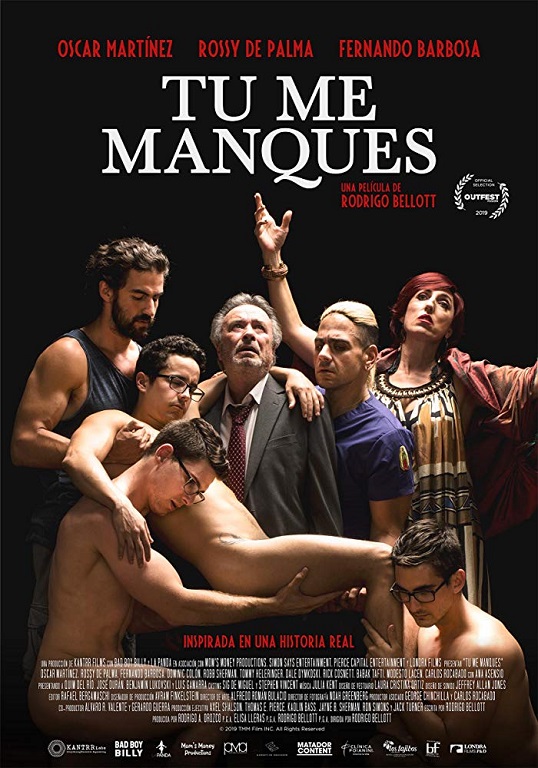
Tu Me Manques, a cinematic expansion of writer Rodrigo Bellott's 2015 play. Young Bolivians Sebastian and Gabriel fall in love at first sight in New York City but, unfortunately, Gabriel's conservative Christian parents refuse to accept his homosexuality. Their relationship ends tragically but Sebastian sees an opportunity to help others through a theatrical production inspired by their story. The film jumps around in time, which can be confusing at times, but it builds to a strong, memorable conclusion. Bellott was awarded a special Jury Prize at Outfest for his screenplay.


The Garden Left Behind is a similarly strong yet sad story about a young trans woman, Tina (played by Carlie Guevara), taking the final steps toward her surgical transition. She has saved money by working as an Uber driver and bartender, has the support of her seemingly accepting boyfriend, and lives with her understanding grandmother. Everything goes well until it doesn't, and then they go from bad to worse in Flavio Alves' sympathetic but arguably too pessimistic film. Name actors Michael Madsen and 89-year old Ed Asner appear in supportive supporting roles.


Kathy Griffin: A Hell of a Story details the horrific treatment the comedian and LGBTQ ally has endured since posting a satiric photo of herself holding a replica of President Donald Trump's severed head two years ago. She was investigated unconstitutionally by the FBI, put on no-fly and Interpol lists, and remains blacklisted by the US entertainment industry. Her new, self-made documentary/stand up movie screened at Outfest prior to a July 31st Fathom Events showing in 700 movie theaters. It serves as both Griffin's latest, hilarious critique of the powers that be as well as a call to arms to LGBTQ and straight Americans alike. Netflix, Hulu, and other streaming services ought to be ashamed if they don't buy and stream this immediately.

And if all these aren't enough for one month, Rocketman – hands down the gayest movie of the year to date – will be out on home video August 27th!

Reverend's Ratings:
Consequences: B
Always Say Yes: A-
Holy Trinity: B-
Label Me: B+
From Zero to I Love You: B
Tu Me Manques: B
The Garden Left Behind: C+
Kathy Griffin: A Hell of a Story: A-

Reviews by Rev. Chris Carpenter, resident film and stage critic of Movie Dearest and Rage Monthly Magazine.

Monday, July 15, 2019

Reverend's Preview: I Scream, You Scream, We All Scream for Outfest


This month’s 37th annual Outfest, the Los Angeles LGBTQ Film Festival, promises to be a scream. Among the approximately 200 short and feature-length films from around the world that will be screened is an eye-opening documentary exploring the gay/anti-gay history of one of the most notorious horror films of all time.


Outfest 2019 runs July 18th-28th at various venues in and around Los Angeles. It is the largest LGBTQ film fest in the world and the largest of the many film festivals that take place in Southern California each year. More than 40,000 attendees, filmmakers, community leaders and others participate in Outfest’s plentiful screenings, panels and parties.

Things will kick off the evening of Thursday, July 18th at the Orpheum Theater with Rachel Mason’s intimate and absorbing documentary, Circus of Books, about LA’s legendary gay pornography emporium run by her parents, Karen and Barry Mason. The film was recently picked up by Netflix. Additional gala screenings include Adam (US Centerpiece), an adaptation of Ariel Schrag’s YA novel directed by Outfest alum and Transparent producer Rhys Ernst; the Sundance hit This Is Not Berlin (International Centerpiece), set within the 1980’s queer music scene in Mexico City; the acclaimed Changing the Game (Documentary Centerpiece), which focuses on three resilient transgender high school athletes fighting to compete amidst national scrutiny; and Straight Up (Breakthrough Centerpiece), a sharp and witty Los Angeles-set comedy written and directed by newcomer James Sweeney, who also stars.


The festival will close in gala fashion on Sunday, July 28th at The Theatre at the Ace Hotel with Hannah Pearl Utt’s Before You Know It, a quirky comedy about two sisters who discover the mother they’d long been told was dead is actually a famous soap star. In addition to Utt, the film’s cast features Judith Light, Alec Baldwin, Tim Daly, Mike Colter and Mandy Patinkin.

In a major change, the majority of screenings are moving this summer from the fest’s longtime home at the Director’s Guild of America building to the TCL Chinese 6 theater complex at Hollywood and Highland. This classic, easily-accessible location is sure to heighten the Outfest experience for many.

I can’t recommend highly enough the special sneak previews on July 20th and 21st of Scream, Queen! My Nightmare on Elm Street. When the horror sequel A Nightmare on Elm Street 2: Freddy’s Revenge was released in 1985, fans thirsting for more Freddy Krueger slasher mayhem weren’t prepared for what became dubbed “the gayest horror movie ever made.” Some consider it the gayest movie ever made, period.


But the film has been re-appraised more recently by scholars as well as documentarians Tyler Jensen and Roman Chimienti. While its original reception derailed the acting career of its gay star, Mark Patton, he is now recognized as the horror genre’s first male “scream queen.” Patton and fellow cast members from the infamous sequel including Freddy himself, Robert Englund, will gather following the Outfest screenings to discuss its legacy and queer aesthetic. The documentary also unapologetically confronts the Hollywood homophobia that ended opportunities for Patton and other gay actors during the height of AIDS hysteria in the mid-1980’s.

Scream, Queen! reveals much about Patton’s personal life, including his own HIV+ status, his longtime self-imposed exile in Puerto Vallarta, and his enduring friendship with singer/actress/goddess Cher. Patton shared even more with me during a recent phone interview:


CC: Have you seen the documentary? What was your reaction to it?
MP: Oh yes. I love it. It’s what I intended it to be. It’s been cut 8 or 9 times over the years. We started working on it five years ago, so I’m very happy with the final version. We’re really hoping for a theatrical release but it will definitely be available for streaming. I really want to protect young people nowadays, and I think the movie raises awareness of a lot of issues affecting LGBTQ young people then and now.

CC: Were you satisfied by your meeting with Freddy’s Revenge screenwriter David Chaskin (shown during the documentary’s climax)? Any follow up thoughts or insights?
MP: Well, I knew he really wasn’t apologizing (for having blamed Patton over the years for the film’s gay interpretation). I often ask audiences after viewing the film, “How many of you have had therapy?” Sometimes it’s all you really get from people. But my desire to confront David ultimately wasn’t about him, it was about me. My main thought watching Freddy’s Revenge for the first time was “Could people tell I was gay?,” which was horrible. Now, I’m completely comfortable with myself. I also realize none of this (the documentary and its positive reception) is happening by accident.


CC: How does it feel to be back in the public eye for the first time in 30 years?
MP: Well, you know I’ve had a gentle slide back in. I flew into Los Angeles the day after they talked to me about the documentary. Then I started the convention thing with Comic-Con and what not. People want to see me, and that feels great. I do have some moments when I’ve been overwhelmed, including in Toronto (during the Toronto Film Festival). It’s one thing when people know you but another as the ripples get bigger and people don’t know you. I’ve learned not to look at social media. But I’ve also heard from people that they consider me a gay icon, which I’m really humbled by.

CC: Speaking of gay icons, here is the question some of my readers will consider the most important: Do you still speak with Cher?
MP: (Laughs) I do. I used to live near Chaz (Bono, Cher’s son) in West Hollywood. Cher lives in a particular world, surrounded by people at her level of success, but she’s always been kind to me. We met when we did the play Come Back to the Five and Dime, Jimmy Dean, Jimmy Dean on Broadway (in 1982; they co-starred in the film version, also released that year). We were very close and are still friends. We would go out to Studio 54 after the show. At the time she always had a dark-haired young man she would be interested in and a blonde young man at her side, so I was her blonde “wing man” at the time (laughs). She remains very supportive and I really hope she comes to see the film at some point.


CC: Do you think you might act more or get otherwise involved in the film industry?
MP: I was literally testing the waters with the two little films I made recently (Family Possessions and Amityville: Evil Never Dies). I know I can do it now. This movie I’m making now in Portland, Black Butee, is a really professional gig. It’s about a serial killer but is a great part. It’s my announcement that the store is open for business! (Laughs).

CC: Finally and more personally, how is married life in Mexico treating you?
MP: Good! I’ve been married for 14 years to a man I never thought I would be with (Hector Morales Mondragon). We met in a club when he started dancing around me. I thought, “Leave me alone!” (laughs). Being in a married relationship takes work. You have to really want it. He’s upstairs right now. We have our fights sometimes, as all couples do, but it’s great.

Visit the official Outfest website for further information about the festival, including the full schedule of films and to purchase passes or tickets.

Preview by Rev. Chris Carpenter, resident film and stage critic of Movie Dearest and Rage Monthly Magazine.

Monday, July 3, 2017

Reverend's Preview: Outfest 2017 Promises to be Fabulous


Nearly 200 LGBTQ short and feature-length films from around the world will be screened during Outfest 2017. That would be a lot of celluloid if movies were still released in non-digital formats. Running July 6th-16th at various venues in and around Los Angeles, the annual festival will be more fabulous than ever thanks to its roster of local premieres.


Outfest began as a three-day media conference on the campus of UCLA way back in 1982. 35 years later, it is the largest LGBTQ film fest in the world and the largest of the many film festivals that take place in LA each year. 40,000 attendees, filmmakers, community leaders and other bigwigs (in some cases, such as the screening of Suspiciously Large Woman: Bob the Drag Queen Comedy Special on July 10th, people literally wearing big wigs) participate in Outfest’s plentiful screenings, panels and parties.

Caftans might actually be fashionable this year thanks to the July 12th debut of The Fabulous Allan Carr. While his name may be unfamiliar to the under-40 crowd, plenty of us more mature gays recall the flamboyant producer of such big-screen musicals as Grease, Grease 2 and Can’t Stop the Music as well as the original Broadway production of La Cage aux Folles. Award-winning documentarian Jeffrey Schwarz (who previously made Vito, I Am Divine and Tab Hunter Confidential) crafted this loving expose of Carr, who also helmed the notorious 1989 Academy Awards ceremony before his untimely death at the age of 62.

“Growing up I was totally obsessed with the movie Grease, which came out when I was nine years old,” Schwarz confessed to me via email. “Unbeknownst to me at the time, there was a visionary producer responsible for making all this magic happen and his name was Allan Carr.”


Schwarz continued: “I was delighted to discover Robert Hofler’s Allan Carr biography Party Animals, and knew right away it had all the elements I look for when choosing a subject. A film adaptation would tie together themes of all my previous documentaries, (which are) stories of visionary mavericks who create larger than life personas to make their dreams a reality; all are stories of outsiders becoming insiders.”

Carr became a multi-millionaire with Grease, which remained the most successful live-action movie musical from 1978 until this year’s Beauty and the Beast. Sadly, he lost much of his fortune not to mention his reputation just two years later when he produced the uber-campy Village People biopic Can’t Stop the Music. “The challenge with The Fabulous Allan Carr was to look beyond the caricature and explore the inner life of a complicated, contradictory man,” Schwarz said.

Schwarz was able to secure the on-camera participation of many of Carr’s friends and collaborators such as Bruce Vilanch, Lorna Luft, Steve Guttenberg, Valerie Perrine, Maxwell Caulfield and more. “So many people wanted to be part of this film because they loved Allan but there were also some who wanted to make sure we saw him as a human being with his own faults and insecurities,” according to Schwarz. “Everyone we spoke to helped present a portrait of a man whose mission in life was to make people happy, but happiness in his own personal life was sometimes elusive.”

I found The Fabulous Allan Carr revelatory in addition to just plain entertaining and can’t recommend it enough. Beyond Outfest, people can follow the film on its website as well as on its Facebook and Twitter pages.


The term fabulous can also be applied to Billy Bloom, the central character of Freak Show. Based on James St. James’ acclaimed novel, Freak Show will serve as this year’s Closing Night Gala screening on July 16th. Making the comedy-drama even more noteworthy is a rare big-screen appearance by newly-anointed Tony Award winner Bette Midler as Billy’s eccentric mother. Laverne Cox and Abigail Breslin, Little Miss Sunshine herself, are also featured.

Billy (played by the extraordinary Alex Lawther) unexpectedly finds himself shipped off to live with his conservative father. His new high school, Ulysses S. Grant Academy, doesn’t take well to Billy’s larger-than-life personality and fashion sense. Just when all seems lost, he finds a friend in the school’s super-cute star football player, who is secretly a budding artist. Newly empowered, Billy goes up against Breslin’s bitchy Bible-thumper for the title of Homecoming Queen. Freak Show is a visually dazzling crowd-pleaser thanks to the participation of legendary cinematographer Dante Spinotti (Beaches, The Mirror Has Two Faces and L.A. Confidential, among many other credits).

Speaking of visually dazzling, there are probably no two more gorgeous men to be found on screen during Outfest than out actor Russell Tovey (of Looking and Pride fame) and Arinze Kene (Fantastic Beasts and Where to Find Them). They co-star in The Pass, screening July 7th, as fellow pro athletes who end up having a complicated relationship. It is a thoroughly unpredictable, ultimately bittersweet romance, and it doesn’t hurt that both in-shape actors are minimally dressed throughout.


This year’s festival isn’t without a fabulous movie musical! Hello Again is a polysexual song and dance saga adapted from Michael John LaChiusa’s celebrated off-Broadway show. The film will have its LA premiere on July 11th. An all-star cast including Martha Plimpton, Audra McDonald, T.R. Knight, Rumer Willis (especially good) and Cheyenne Jackson play an assortment of intertwined lovers who cross paths over the course of 12 decades. Tom Gustafson, who previously helmed the 2008 Outfest hit musical Were the World Mine, directs.

Opening night on July 6th will feature the LA premiere of Sundance award winner God’s Own Country, a love story between a British sheep farmer and a Romanian migrant worker. Also, openly gay TV producer Bryan Fuller (American Gods, Hannibal and Pushing Daisies) will be presented with the 2017 Outfest Achievement Award.

All in all, Outfest 2017 is going to be fabulous. Visit the Outfest website for the full festival schedule and to purchase tickets.

Review by Rev. Chris Carpenter, resident film and stage critic of Movie Dearest and Rage Monthly Magazine.

Wednesday, July 6, 2016

Reverend's Preview: Who Ya Gonna Call for LGBTQ Movies? Outfest!


Lesbian lawmakers, real-life gay porn stars, the world’s first lady ghostbusters and sexually-searching Asian Americans will headline some of the most anxiously anticipated movies at Outfest 2016 this month.


The 34th annual Los Angeles LGBT Film Festival runs July 7th-17th at multiple venues in the LA/Hollywood area, including the newly-renovated Ford Amphitheater. The Ford wasn’t available last summer for Outfest’s popular outdoor screenings, of which only one was presented at Hollywood Forever Cemetery.


This year’s Outfest audiences will be among the first to check out what they’ve done to the revamped Ford. Five films will be shown there, including the LA premiere of a rebooted Ghostbusters featuring an all-star female cast. Comedy heavyweights Kristen Wiig, Melissa McCarthy, Kate McKinnon and Leslie Jones inherit the proton packs from their male 1980’s predecessors in an effort to stop evil supernatural forces from taking over Manhattan. They wisely hire Chris Hemsworth of Thor and The Avengers fame as their hunky receptionist, taking over from the decidedly brainier Annie Potts in the original Ghostbusters flicks.

Also screening at the Ford will be Kiki, the fest’s Documentary Centerpiece exploring today’s NYC drag ball scene not unlike the classic Paris is Burning; the world premiere of the fur-infused men’s sequel BearCity 3; Modern Love, another world premiere about a gay couple facing challenges on the eve of their wedding; and the closing night comedy Other People, starring Jesse Plemons (TV’s Fargo and Breaking Bad), Molly Shannon, Bradley Whitford and Silicon Valley’s Zach Woods.


Christopher Racster, Outfest’s Executive Director, and Director of Programming Lucy Mukerjee-Brown wrote in a joint statement: “What better time or place to revel in our own stories — and to discover the commonalities within our own community — than Outfest Los Angeles? Our hope is that you will walk away from this year’s festival with a deeper understanding of the breadth of our community.”

Political Animals, one of the fest’s Spotlight screenings on July 14th, is essential viewing for anyone interested in our LGBT history. It premiered at last month’s LA Film Festival and ended up walking away with both the Jury and Audience Awards for Best Documentary.


Sheila Kuehl, Christine Kehoe, Jackie Goldberg and Carole Migden were the only openly lesbian or gay California state representatives in the 1990’s-early 2000’s. Individually and collectively, they took on Governor Pete Wilson’s 1990 veto of the state’s first gay rights bill, the first effort to ban anti-gay bullying in public schools in 1996, and the Pentagon’s “Don’t Ask, Don’t Tell” policy. They also worked on behalf of people with AIDS and established California’s domestic partnership registry.

The inspiring documentary is nicely structured by director Jonah Markowitz, who provides incisive, insightful examinations of each legislator’s personal background as well as their political career. Most dramatically, it literally shows how far California and the nation have come over the last 26 years in accepting their LGBTQ citizens thanks to these four women. The film culminates in a modern-day dinner scene with the quartet at which they humbly declare “we didn’t know we would be such groundbreakers.” Of note, Kuehl is today an LA County Supervisor.


Making its US premiere at Outfest on July 13th will be the long-awaited movie version of Holding the Man. Based on the autobiography of Australian actor and playwright Timothy Conigrave, it recounts the romantic but ultimately heartbreaking love story between Conigrave and John Caleo. After meeting in high school, where Caleo was captain of their football team, the pair forged a relationship that’s been referred to as Australia’s Brokeback Mountain. Name actors Guy Pearce, Anthony LaPaglia and Kerry Fox play supporting roles in this sure-to-be-memorable film.

Women He’s Undressed is another film with roots Down Under screening on July 9th. This fantastic documentary by excellent Australian director Gillian Armstrong (My Brilliant Career, Starstruck, the 1994 adaptation of Little Women) uncovers the little known life of gay, Oscar-winning costume designer Orry-Kelly. Armstrong utilizes both interviews with his still-living peers and dramatic re-creations of episodes from the designer’s life, including his secret affair with Cary Grant.


Rounding out my recommendations of movies to catch at Outfest 2016 are Looking: The Movie, the big-screen conclusion of HBO’s series about three gay friends living in San Francisco; a special screening of 1983’s bisexual vampire love story The Hunger, co-starring the late David Bowie; Spa Night, starring Sundance Breakthrough Performance Award winner Joe Seo as a Korean-American man who discovers his homosexuality when he takes a job at a men’s health club; the US premiere of Outfest UCLA Legacy Project’s revelatory restoration of the 1919 German film Different from the Others, the earliest surviving positive portrayal of a gay protagonist; and King Cobra, inspired by the real-life struggle of two competitors over the career of gay adult superstar Brent Corrigan.

In addition to a star-making performance by Garrett Clayton as Corrigan, the cast of King Cobra boasts James Franco (who also produces), Molly Ringwald, Alicia Silverstone and Christian Slater. Franco will be presented with Outfest’s inaugural James Schamus Award, honoring his considerable efforts to bring LGBTQ stories to the forefront of current cinema, immediately prior to the film’s screening on July 16th.

For the full festival schedule and to purchase passes or tickets, visit the Outfest website.

Preview by Rev. Chris Carpenter, resident film and stage critic of Movie Dearest and Rage Monthly Magazine.

Monday, July 6, 2015

Reverend's Preview: Old & New Faces at Outfest 2015


Despite the resignations this past year of two prominent leaders (Executive Director Kirsten Schaffer and Director of Programming Kristin Pepe) as well as the temporary loss of the Ford Theatre (which is undergoing a long-overdue renovation) Outfest is still going strong. The 33rd annual Los Angeles LGBT Film Festival runs July 9th-19th at both traditional and new venues in the Los Angeles/Hollywood area.


Christopher Racster, Outfest’s Interim Executive Director, and Long Beach resident Lucy Mukerjee-Brown, the fest’s new Director of Programming, promise that the films being showcased this year “increase our visibility.” They went on to say that “sharing them strengthens understanding and, in turn, creates meaningful change.”

One of the most prominent examples of this may be the July 16th screening of 54: The Director’s Cut at Hollywood Forever Cemetery. Mark Christopher’s 1998 historical drama about New York City’s famed nightclub Studio 54 underwent extensive re-editing prior to its original release that removed virtually all of its gay and bisexual content. Fortunately, the director was finally allowed last year to restore his original vision and 36 minutes to the film, which stars studly Ryan Phillippe as a bartender with dreams of fame and Mike Myers (yes, Austin Powers himself) in a rare dramatic role as club owner Steve Rubell.

While the new and presumably improved 54 wasn’t made available to critics in advance, I was able to preview several of this year’s other Outfest selections:


Eisenstein in Guanajuato: Auteur/provocateur Peter Greenaway (The Cook, The Thief, His Wife & Her Lover; The Pillow Book) returns with this explicit examination of the relationship between acclaimed Russian filmmaker Sergio Eisenstein and Palomino, the man who served as his guide during Eisenstein’s trip to Mexico in the 1930's. I found Greenaway’s treatment here of both men a little too broad and cartoonish but their true love story remains appealing. The film will screen in the International Centerpiece slot at the Director’s Guild of America on July 13th.

Those People: An affecting coming-of-age tale set in the Big Apple of a young artist fixated on his non-committal best friend, who also happens to be the socially-despised son of a Bernie Madoff-ish swindler. Writer-director Joey Kuhn gets extra credit for incorporating numerous Gilbert & Sullivan tunes on the soundtrack. It screens on July 18th.


Drown: This winner of several awards at May’s FilmOut San Diego is a time-tripping exploration of an Australian lifeguard’s conflicted feelings for his new, gay teammate. It is a dark film focusing on the awful toll repression can take but the finale isn’t as depressing as one may fear initially. There is also plentiful eye candy thanks to its hot, Speedo-clad cast.

Everlasting Love: OK, this one was too dark for me and I’m hardly a Pollyanna. A teacher begins an illicit affair with a gay student, whom he encounters while cruising in the woods one day. The student doesn’t take it very well, however, when his teacher decides to end their relationship. Spanish director Marcal Fores’ bad romance is being termed Hitchcockian but pushes the envelope a bit too far. More adventurous Outfest-goers might consider it just fine.


Do I Sound Gay?: Filmmaker and primary subject David Thorpe set out to discover if there really is a “gay voice” and, if so, how did it develop. Entertaining if frequently self-indulgent, this documentary presents such disparate suspects as Hollywood golden age actor Clifton Webb (Laura, 1953’s Titanic), gay comedians Paul Lynde and Charles Nelson Reilly, and The Lion King’s villainous Scar as all at least partly responsible for making the majority of gay men sound alike, depending upon which generation we came of age.

Seed Money: The Chuck Holmes Story: A compelling documentary about Chuck Holmes, the unassuming Midwest farm boy who founded Falcon Studios in the late 1970’s and watched it become “the MGM of gay porn.” Director Michael Stabile captures Holmes’ difficulties during the 1980’s particularly well, when the pornographer found himself at the uncomfortable center of the convergence of AIDS, politics and economics.


Beautiful Something: This thoughtful, very sexy drama is the best offering I was able to see in advance of Outfest. Writer-director Joseph Graham (Strapped) follows several gay men of different generations living in Philadelphia during one life-altering night. Alternately funny and heartbreaking, it is also one of the few American films seen to feature an ethnically-diverse cast. I strongly recommend this one.

Actor-writer-director John Cameron Mitchell, best known for the boundary-pushing Hedwig and the Angry Inch and Shortbus, will be honored with the 2015 Outfest Achievement Award during the opening night gala on July 9th. For the full festival schedule and to purchase passes or tickets, visit the Outfest website.

Preview by Rev. Chris Carpenter, resident film critic of Movie Dearest and Rage Monthly Magazine.

Friday, July 25, 2014

Reverend’s Report: Last Weekend at Outfest 2014


Outfest, the 10-day Los Angeles LGBT Film Festival, began to draw to a close last weekend with, appropriately enough, the LA premiere of Tom Dolby and Tom Williams’ lovely dramedy Last Weekend. Featuring an award-worthy performance by the never-disappointing Patricia Clarkson (The Station Agent, Far from Heaven) that fully utilizes her sensitivity, comedic timing and other distinctive acting gifts, the movie is well worth keeping an eye out for once it hits theaters or home video.


Clarkson heads an excellent cast as Celia, matriarch of the all-male Green family consisting of husband Malcolm (Chris Mulkey), son Roger (Joseph Cross, all grown up since his early turns in such late-90’s films as Wide Awake and Jack Frost) and other, gay son Theo (Zachary Booth, who also played the closeted lawyer in 2012’s acclaimed Keep the Lights On). The boys have come home to the family’s Lake Tahoe cabin for Labor Day weekend at Celia’s behest, with successful TV writer Theo bringing an entourage of friends, his latest flame Luke (pretty Devon Graye) and the star of his current hit show (Glee’s Jayma Mays).

Unbeknownst to their sons initially, Celia and Malcolm are considering selling their longtime manse in an effort to downsize. Unbeknownst to Celia and Malcolm initially, corporate accountant Roger has just lost his job after making a $30 million error. These are the primary conflicts in Dolby’s screenplay, with the developing relationship between Theo and Luke a bit more incidental. Celia’s realization that “it’s hard to let go of things” — whether talking about possessions, people or the past — is belabored at times but is also affecting, thanks in no small part to Clarkson’s emotional palette. The film is also well-supported visually by Paula Huidobro’s beautiful cinematography and aurally by Stephen Barton’s Thomas Newman-esque score. There are also terrific acting turns by Judith Light as the Greens’ grasping neighbor and Mary Kay Place as a lesbian townie.

Dolby, who is gay, introduced the film’s Outfest screening by giving a sweet, heartfelt tribute to Williams. He revealed that the co-directors have been best friends for over 20 years and that Williams has been his “straight ally” since they first met in college. The visibly moved Williams could barely utter a word after Dolby spoke. It served as a nice testimony not only to the growing diversity of LGBT-inclusive movies but of those filmmakers who create them.


Numerous LGBT-interest documentaries debut during Outfest each year, and this year was no exception. Two stood out for me as particularly revelatory in addition to being exceptionally well-made. Swiss filmmaker Stefan Haupt’s The Circle uses an engrossing combination of vintage footage, modern-day interviews and dramatic re-creations in its exploration of a Europe-based international gay network that thrived prior to the rise of the Nazis. Haupt centers on the romantic saga of two men who met at the time through the Circle and are not only still alive but still together 70 years later. The film was rightly awarded this year’s Outfest Grand Jury Award for Best Documentary Feature as well as the Teddy for Best LGBT Film at the 2014 Berlin Film Festival.

Jim Tushinski’s I Always Said Yes: The Many Lives of Wakefield Poole served as a similar eye-opener. While known to me and many as the pioneering gay porn filmmaker of the late 1960’s-early 1970’s, I had no idea that Poole was first a professional dancer with the renowned Ballets Russes as well as a successful Broadway dancer-choreographer. After an ugly legal clash with composer Richard Rodgers during the original production of Do I Hear a Waltz? essentially ended Poole’s Broadway career (although he made a brief comeback in the late 70’s), he began producing short films for art exhibitions and eventually exploited his eye for glossily explicit men’s stories. Poole’s Boys in the Sand became a surprising crossover smash hit, a gay porn epic that drew gay men, straight men and women alike. Tushinski’s film accomplishes what the best docs do, informing and entertaining in spades.


As such, I Always Said Yes stood in stark contrast with Back on Board: Greg Louganis. This latest exposé of the gay, HIV+ Olympic diver offers little that is new to anyone who has read his autobiography, Breaking the Surface, or seen the Mario Lopez-starring TV movie adapted from, it apart from Louganis’ more recent financial woes. Back on Board isn’t particularly interesting or well made yet it inexplicably won Outfest’s Audience Award for Best Documentary Feature, presumably because the voting audience was stacked with the subject’s numerous local friends.

Rounding out the docs I saw were Alec Mapa: Baby Daddy, a very funny yet disarmingly moving film of the “Gaysian” comedian’s stand up routine detailing his and his husband’s tireless efforts to adopt a child, and Andrea Meyerson’s Letter to Anita, an interesting bio of trailblazing lesbian educator-activist Dr. Ronni Sanlo that is unfortunately marred by the oddly journalistic employment of out actress Meredith Baxter. The numerous shots of Baxter sitting on a stool, bottle of water at her side, reading from Sanlo’s decades-old missive to anti-gay crusader Anita Bryant become laughable. Still, Sanlo’s inspiring life shines through the directorial excess.

Reverend’s Ratings:
Last Weekend: B+
The Circle: A-
I Always Said Yes: The Many Lives of Wakefield Poole: A
Back on Board: Greg Louganis: C
Alec Mapa: Baby Daddy: B
Letter to Anita: B

Report by Rev. Chris Carpenter, resident film critic of Movie Dearest and Rage Monthly Magazine.
Wednesday, July 9, 2014

Reverend’s Preview: Dead & Loving It at Outfest 2014


The dead are rising all over large and small screens nowadays. One new movie about a restless ghost/zombie, Jamie Marks is Dead, caused a homoerotic stir at January’s Sundance Film Festival. It will be making its Los Angeles premiere on July 11th as part of Outfest, which runs July 10th-20th.


Jamie is a bullied teenager whose body is found in the woods by a local girl, Gracie. Soon after, Jamie begins appearing not only to Gracie but to Adam, her track star semi-boyfriend. Adam finds himself increasingly drawn to the underwear-clad specter and, as he tries to discover how Jamie died, has to confront his emerging romantic feelings for his unusual friend.

It is rare for a film to be creepy, sexy and deeply moving, often all at the same time. Openly gay filmmaker Carter Smith (who previously helmed the horror movie The Ruins) walks an impressive high wire act with Jamie Marks is Dead, and the result is one of the best entries at this year’s Outfest. Smith chatted with me in advance of the event.


CC: What spoke to you about the novel One for Sorrow that made you want to film it?
CS: I randomly picked up the book in a book store. I was about halfway through it and thought, “This would make a great film.” Christopher Barzak’s story was beautiful and I loved the honesty in the relationships between Jamie and Adam, and Adam and Gracie. It felt very real and not a fictional version of what adults think teenagers are.

CC: Did you relate to this story on a more personal level?
CS: I grew up in a very small town in rural Maine that was not all that dissimilar from where the film takes place. I know what it is to live in an isolated way. I also responded to the relationship between Adam and Jamie as well as between Adam and Gracie, trying to figure out who they are. It isn’t really a coming out story but explores that more fluid time in a young person’s development.

CC: How has your film been received so far? Any unusual or surprising reactions?
CS: It’s always interesting to see how a film like this with a very specific milieu affects people outside it. I’ve had great conversations with middle-aged women and schoolteachers about some of the issues explored. Then there’s the Sundance crowd that just loves a good story.

CC: What led you to cast Noah Silver (best known as Benito Sforza on The Borgias) as Jamie and Cameron Monaghan (who plays Shameless’ Ian Gallagher) as Adam?
CS: We spent a long time looking, looking at people with a lot of experience and just a little experience. Noah actually put himself on tape two years ago playing both Adam and Jamie. It was when I put Noah and Cameron together that I noticed, “This is going to be an interesting contrast,” both physically and emotionally.


CC: How did out, Oscar-nominated screenwriter John Logan (Gladiator, Skyfall) come on as a co-producer?
CS: I had met John and been friendly with him and at dinner one night he asked, “So, what are you working on?” I told him about the script and he was really interested. He asked me to send it to him. I did, and he read it and replied saying he loved it and really wanted to do it. He was passionate. He really wanted to stay true to the emotional aspect of it, as did I. We didn’t want it to become just a horror film.

CC: The film isn’t being billed as a gay-themed movie per se. Is this intentional? Are you wanting a broader audience?
CS: Hopefully it will play to a broader audience, but the LGBT community is going to respond to certain themes and parts of it. It’s also gotten a great response from the horror film community for the same reason.

CC: What’s next for you?
CS: I’m writing something which I’m really excited about but can’t really talk about yet. I’m also reading stuff and looking for ideas. But my day job is still fashion photography, which is where I got my start. I’m shooting Chloe Moretz (star of the Kick-Ass movies and the recent remake of Carrie) tomorrow for the cover of Allure magazine.

CC: Nice. Thanks so much for taking the time to speak with me. Best of luck with Jamie Marks and in the future.
CS: Thank you. I’m so glad you liked the film.


Outfest is never short on homoerotic or just downright erotic gay-themed films. A few I recommend this year are:

  • The Way He Looks, a Brazilian tale of two high school best friends who discover they have a deeper interest in one another. Oh, and one of them is blind, adding some needed novelty to the gay coming of age genre. It will screen in the International Centerpiece slot on July 14th.
  • Eternity: The Movie, a funny satire set in the 1980’s and focusing on the two men who make up the title R&B sensation. Any resemblance between Eternity and Hall & Oates is totally intentional. It screens on July 11th.
  • Tiger Orange, in which Frankie Valenti (a.k.a. porn star Johnny Hazzard) gives an impressive dramatic performance as one of two gay brothers (the other is played by Mark Strano) trying to bring closure to their troubled past. Never fear, Hazzard fans: he still takes his clothes off. The film will have its world premiere on July 18th.
  • Gerontophilia, Bruce LaBruce’s acclaimed dramedy about a young man who has the hots for decidedly older gentlemen, eventually falling in love with a resident of the nursing home in which he works. Screens on July 17th.
  • The Third One, who happens to be a sexy, younger guy invited by a gay couple he meets online to dinner and more at their home. This disarming, insightful and, yes, hot film from Argentina will screen on July 15th.
  • I Always Said Yes: The Many Lives of Wakefield Poole, an explicit, revealing documentary about the ballet dancer/choreographer who became a pioneering gay porn filmmaker in the 1970’s. Screens on July 12th.


James Schamus, screenwriter (The Wedding Banquet, The Ice Storm, Taking Woodstock), producer (Poison, Swoon, Brokeback Mountain) and former CEO of Focus Pictures (Milk, The Kids Are All Right, Dallas Buyers Club) will be receiving the 18th annual Outfest Achievement Award during the festival's Opening Night Gala on July 10th. Outfest's highest honor, the Achievement Award is presented in recognition of a body of work that has made a significant contribution to LGBT film and media.

For the full film schedule and to purchase passes or tickets, visit the Outfest website.

By Rev. Chris Carpenter, resident film critic of Movie Dearest and Rage Monthly Magazine.

Wednesday, July 2, 2014

Reverend’s Interview: Barry Sandler on Crimes of Passion’s 30th Anniversary


In 1984, one of the most daring motion pictures to date about human sexuality, Crimes of Passion, was released. Kathleen Turner stars as call girl China Blue, who by day is a talented fashion designer. Her already conflicted life becomes even more complicated once she crosses paths with both a repressed husband (played by a full-frontal, totally hot John Laughlin) and an insane street preacher intent on “saving” her (the late Anthony Perkins, giving his most out there performance among many).


The film’s screenwriter, Barry Sandler, will be appearing at a special 30th anniversary screening sponsored by Outfest tonight in West Hollywood. He currently lives in central Florida and teaches filmmaking at a local university. I was privileged to speak with Sandler at length recently about Crimes of Passion and several of his other memorable — and memorably gay-aware — works.

Rev: Where did the idea or story of Crimes of Passion come from?
Sandler: (Laugh) You know, I started writing it in the late 1970’s, during the sexual revolution and pre-AIDS. It was clear to me that people were substituting sex for intimacy, as a substitute for any kind of romance. I was trying to convey that using a dramatic hook, how sexuality is sometimes used as a shield or a barrier to real connection. I used a heterosexual context but I thought gay viewers could relate to it. I knew I succeeded when I went out on Halloween that year and saw how many men were dressed as China Blue (laughs)!

Rev: How was the film received upon its initial release?
Sandler: I never had or even seen a movie that had such polarized reactions. I have a list of critics who loved it and thought it was brilliant, and then there were a lot of critics who said it was depraved and disgusting. The other thing is that it got a lot of publicity because the ratings board gave it an X rating, so there were two versions of it ultimately released on home video: R and Unrated. Richard Heffner, the head of the ratings board at the time, encouraged me as a producer on the film to release it as an X and restore the legitimacy of the X rating. Midnight Cowboy, which won the Oscar, had been rated X before it became synonymous with pornography. Heffner defended Crimes of Passion as a serious treatment of human sexuality. The studio (New World), though, would only release it as an R. It had disappointing box office since everyone had naturally been looking forward to the X-rated version but it became something of a cult movie and was big on home video, especially the unrated version.

Rev: I think Kathleen Turner gives one of her best performances as China Blue. What was she like on set?
Sandler: She is great in it. She won the Los Angeles Film Critics award and is on the record as saying it’s her best performance. It was a difficult, intense shoot because her fiancée didn’t want her to do it. She was just coming off Romancing the Stone and was a big star. She was a little bit nervous doing this subversive, transgressive role but the actress in her really wanted to do it.


Rev: As screenwriter, how was working with the one and only director Ken Russell (The Devils, Tommy, Women in Love and nearly 70 other films, many of them controversial)?
Sandler: I loved it, it was just great. He had just done Altered States, written by Paddy Chayefsky, and they did not get along. Paddy had it in his contract that not a word of his script could be changed without his permission. They fought a lot, so (Russell) was very skeptical and suspect of the idea of working with me, since I had it in my contract that I had to write any changes in the script. I wasn’t opposed to changes but I had to make them. The first time I met with Ken, he was a little bit standoffish and aloof. I really wanted to work with him, and had such respect and admiration for him as a filmmaker. It took a couple of meetings but he eventually warmed up to me. We also didn’t really make any changes. We were going to make another movie after Crimes of Passion but the financing never came together.

Rev: Making Love (which Sandler wrote and produced) also got a mixed reaction when it was released in 1982. Would you say its reputation has improved?
Sandler: I would say so, yeah. Critics were divided on it but not as polarized as Crimes of Passion. It was warmly embraced by the gay community. My generation grew up with all these negative stereotypes of gay people. I still have a lot of the nice clippings in the gay press and letters I received at the time. Some people were confused by it because it was sold in two different ways: to the straight audience and the gay audience. I remember seeing it in a theater full of mostly straight people. When the two men kissed, some people groaned and some even got up and left the theater. I don’t think that would happen today. There really aren’t these two different audiences anymore, which is great.


Rev: And you wrote what most of my friends and I consider two of the best Agatha Christie movies, The Mirror Crack’d (1980) and Evil Under the Sun (1982). How were those experiences?
Sandler: (Laugh) I had the most fun because I got to live in England for months and meeting and working with all these big stars on The Mirror Crack’d: Elizabeth Taylor and Kim Novak, Rock Hudson, Angela Lansbury, Tony Curtis. It was Kim Novak’s first movie in a while and I remember her being pretty nervous. Liz Taylor was great. I would quote lines from her movies to her and ask her to guess which movie each was from. She got about half of them right. (Laughs) Unfortunately, I wasn’t on set when they filmed Evil Under the Sun because they were shooting Making Love at the same time.

Rev: What are you working on now?
Sandler: I just finished a movie, Knock ‘em Dead, that is a lot like the Agatha Christie movies. It comes out in February. It has an all-black cast and is very low budget but it’s a lot of fun. (The film is directed by David DeCoteau, the out mastermind behind The Brotherhood and 1313 series.)

Rev: Any thoughts on how far cinema has come from an LGBT perspective?
Sandler: I tell you, we’ve come along an enormous amount, mainly thanks to television. Once you have gay people, gay characters coming into your home, it really de-stigmatizes us. The more that image of gay people as non-threatening is out there, the more accepted we are. We have really come a long, long way.

Interview by Rev. Chris Carpenter, resident film critic of Movie Dearest and Rage Monthly Magazine.